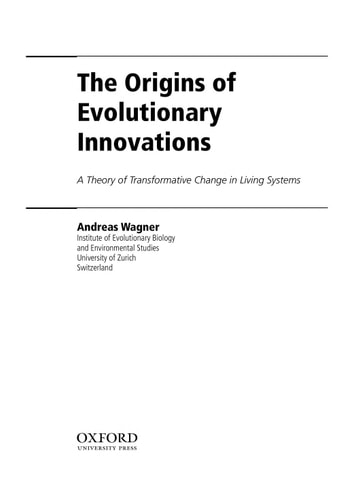
The Origins of Evolutionary Innovations: A Theory of Transformative Change in Living Systems
0
0
As an Amazon Associate and affiliate partner, Menrva Books earns from qualifying purchases. Learn more
Author Description
The history of life is a nearly four billion year old story of transformative change. This change ranges from dramatic macroscopic innovations such as the evolution of wings or eyes, to a myriad of molecular changes that form the basis of macroscopic innovations. We are familiar with many examples of innovations (qualitatively new phenotypes that can provide a critical benefit) but have no systematic understanding of the principles that allow organisms to innovate. This book proposes several such principles as the basis of a theory of innovation, integrating recent knowledge about complex molecular phenotypes with more traditional Darwinian thinking. Central to the book are genotype networks: vast sets of connected genotypes that exist in metabolism and regulatory circuitry, as well as in protein and RNA molecules. The theory can successfully unify innovations that occur at different levels of organization. It captures known features of biological innovation, including the fact that many innovations occur multiple times independently, and that they combine existing parts of a system to new purposes. It also argues that environmental change is important to create biological systems that are both complex and robust, and shows how such robustness can facilitate innovation. Beyond that, the theory can reconcile neutralism and selectionism, as well as explain the role of phenotypic plasticity, gene duplication, recombination, and cryptic variation in innovation. Finally, its principles can be applied to technological innovation, and thus open to human engineering endeavours the powerful principles that have allowed life's spectacular success.
Menrva's Summary
THE THESIS
This book investigates the fundamental principles that govern how living systems produce qualitatively new phenotypes, or evolutionary innovations. Andreas Wagner, a professor of evolutionary biology, synthesizes recent advancements in molecular biology with classical Darwinian theory to propose a unified framework for understanding transformative change. By examining the architecture of genotype networks, the author argues that biological robustness and environmental interaction are the primary drivers of innovation across all levels of life, from molecular circuits to complex macroscopic structures.
THE SCOPE MAP
What You Will Find
- Analysis of genotype networks within metabolism, regulatory circuitry, proteins, and RNA molecules.
- A theoretical framework integrating neutralism, selectionism, and phenotypic plasticity.
- Examination of mechanisms such as gene duplication, recombination, and cryptic variation.
- Application of biological innovation principles to human engineering and technological development.
THE AUTHORITY PERSPECTIVE
Experts recognize this work as a significant contribution to the field of evolutionary systems biology, noting its ambitious attempt to formalize the mechanisms of innovation. Readers frequently highlight the technical density of the prose, which requires a foundational understanding of genetics and evolutionary theory to fully grasp the author's arguments.
Page Count:
272
Publication Date:
2011-09-15
Publisher:
Oxford University Press
ISBN-10:
0199692602
ISBN-13:
9780199692606
Science
Genetics
Biology
Evolutionary Biology
Community Tags
Similar Books