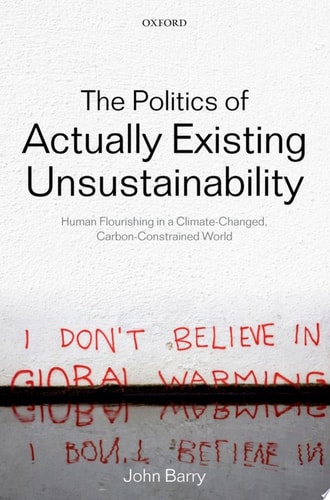
The Politics of Actually Existing Unsustainability: Human Flourishing in a Climate-Changed, Carbon Constrained World
0
0
As an Amazon Associate and affiliate partner, Menrva Books earns from qualifying purchases. Learn more
Author Description
Going against both the naive techno-optimism of 'greening business as usual' and a resurgent 'catastrophism' within green thinking and politics, The Politics of Unsustainability offers an analysis of the causes of unsustainability and diminished human flourishing. It makes a case for seeing that it is profound and deepening unsustainability and growing injustice that characterises the modern world, and that therefore the focus of green or other progressive thinking should shift from its current framing in terms of 'sustainability', 'sustainable development', and 'theories of justice'. The book locates the causes of unsustainability in dominant capitalist modes of production, debt-based consumer culture, the imperative for orthodox economic growth, and the dominant ideology of neo-classical economics. At the level of developing a progressive and critical theoretical understanding of unsustainability, it argues for the importance of integrating vulnerability, which has been largely neglected by both mainstream western political theory and analyses of the current global ecological crisis. It suggests that valuable insights into the causes of and alternatives to unsustainability can be found in a critical embracing of human vulnerability and dependency as both constitutive and ineliminable aspects of what it means to be human. Rather than seeing invulnerability as the appropriate response, the book defends resilience, and the ability to 'cope with' rather than 'solve' vulnerability, as more productive. The Politics of Unsustainability offers a trenchant critique of the dominant neo-classical economic groupthink, which the book argues must be seen not as some value neutral form of 'expert knowledge' but as a thoroughly ideological 'commonsense' that has corrupted and limited creative ways of thinking about and through our current predicament. It offers a green political economic alternative which replaces economic growth with economic security, and views economic growth
Menrva's Summary
THE THESIS
This book investigates why current frameworks of sustainability and sustainable development fail to address the systemic causes of ecological crisis and diminished human flourishing. John Barry, a professor of green political economy, challenges the prevailing reliance on neo-classical economic growth and techno-optimism. He argues that modern society must shift its focus toward acknowledging human vulnerability and dependency as foundational elements of a new, resilient political and economic framework.
THE SCOPE MAP
What You Will Find
- A critique of neo-classical economic ideology and its role in perpetuating unsustainable production models.
- An analysis of the limitations inherent in current 'sustainable development' policy discourse.
- A theoretical integration of human vulnerability and dependency into political and ecological theory.
- A proposed shift from economic growth imperatives toward models centered on economic security and resilience.
THE AUTHORITY PERSPECTIVE
Scholars in the field of environmental politics recognize this work as a rigorous challenge to mainstream green policy discourse. Readers frequently note the academic density of the prose, which serves as a foundational text for those examining the intersection of political economy and climate change.
Page Count:
336
Publication Date:
2012-04-30
Publisher:
Oxford University Press
ISBN-10:
0199695393
ISBN-13:
9780199695393
Economics
Philosophy
Sustainability
Green movement
Community Tags
Similar Books
Reader Comments
Share Your Thoughts
No comments yet. Be the first to share your thoughts!