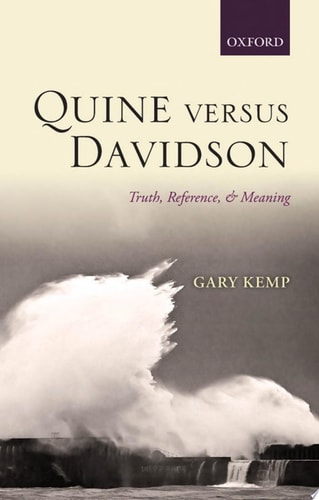
Quine versus Davidson: Truth, Reference, and Meaning
0
0
As an Amazon Associate and affiliate partner, Menrva Books earns from qualifying purchases. Learn more
Author Description
Gary Kemp presents a penetrating investigation of key issues in the philosophy of language, by means of a comparative study of two great figures of late twentieth-century philosophy. So far as language and meaning are concerned, Willard Van Orman Quine and Donald Davidson are usually regarded as birds of a feather. The two disagreed in print on various matters over the years, but fundamentally they seem to be in agreement; most strikingly, Davidson's thought experiment of Radical Interpretation looks to be a more sophisticated, technically polished version of Quinean Radical Translation. Yet Quine's most basic and general philosophical commitment is to his methodological naturalism, which is ultimately incompatible with Davidson's main commitments. In particular, it is impossible to endorse, from Quine's perspective, the roles played by the concepts of truth and reference in Davidson's philosophy of language: Davidson's employment of the concept of truth is from Quine's point of view needlessly adventurous, and his use of the concept of reference cannot be divorced from unscientific 'intuition'. From Davidson's point of view, Quine's position looks needlessly scientistic, and seems blind to the genuine problems of language and meaning. Gary Kemp offers a powerful argument for Quine's position, and in favour of methodological naturalism and its corollary, naturalized epistemology. It is possible to give a consistent and explanatory account of language and meaning without problematic uses of the concepts truth and reference, which in turn makes a strident naturalism much more plausible.
Menrva's Summary
THE THESIS
This book investigates the fundamental incompatibility between the philosophical frameworks of Willard Van Orman Quine and Donald Davidson regarding the nature of truth, reference, and meaning. Gary Kemp, a scholar of analytic philosophy, examines the tension between Quine’s methodological naturalism and Davidson’s interpretive theories. By analyzing their respective approaches to language, Kemp argues that Quine’s naturalized epistemology offers a more consistent and explanatory account of meaning than Davidson’s framework, which Kemp characterizes as relying on unscientific intuitions.
THE SCOPE MAP
What You Will Find
- A comparative analysis of Quinean Radical Translation versus Davidsonian Radical Interpretation.
- An examination of the role of truth and reference in twentieth-century analytic philosophy.
- A defense of methodological naturalism as a superior framework for linguistic inquiry.
- A critical assessment of the divergence between scientistic and intuition-based approaches to meaning.
THE AUTHORITY PERSPECTIVE
Scholars and students of analytic philosophy recognize this work as a rigorous contribution to the ongoing debate between Quine and Davidson. Readers frequently note the technical density of the prose, which assumes a foundational understanding of twentieth-century philosophy of language.
Page Count:
192
Publication Date:
2012-05-04
Publisher:
Oxford University Press
ISBN-10:
0199695628
ISBN-13:
9780199695621
Philosophy
Metaphysics
Epistemology
Community Tags
Similar Books