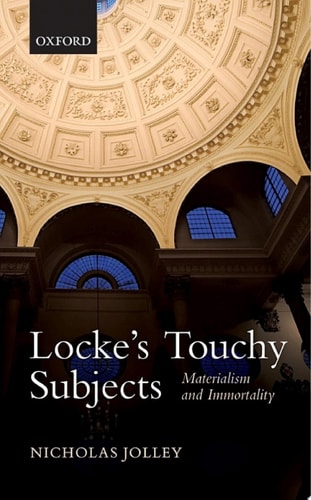
Locke's Touchy Subjects: Materialism and Immortality
0
0
As an Amazon Associate and affiliate partner, Menrva Books earns from qualifying purchases. Learn more
Author Description
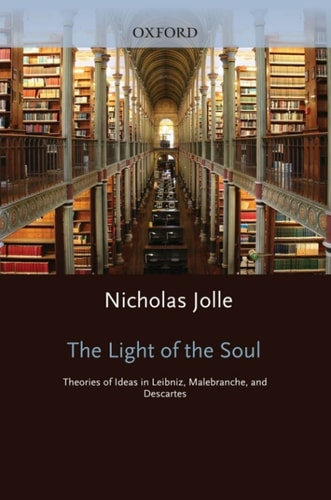
In seventeenth-century philosophy the mind-body problem and the nature of personal immortality were two of the most controversial and sensitive issues. Nicholas Jolley seeks to show that these issues are more prominent in Locke's philosophy than has been realized. He argues further that Locke takes up unorthodox positions in both cases. Although Locke's official stance on the mind-body problem is agnostic, in places he presents arguments that, taken together, amount to a significant case for a weak form of materialism. Locke also seeks to show that the solution to the mind-body problem is irrelevant to the issue of personal immortality: for Locke, such immortality is conceptually possible even if the same body is not resurrected at the Day of Judgment. Jolley throws new light on such central topics in An Essay Concerning Human Understanding as substance and personal identity: he also pays close attention to such neglected topics as his account of the status of animals and his polemic against the thesis that the mind always thinks. Throughout, the book examines Locke's arguments against the background of Descartes' views. Jolley argues that Locke's criticisms of Descartes are no mere defences of common sense against dogmatism; rather, they are controversial responses to some of the most challenging metaphysical and theological issues of his time.
Menrva's Summary
THE THESIS
This book investigates the extent to which John Locke held unorthodox positions regarding the mind-body problem and personal immortality. Nicholas Jolley, a scholar of early modern philosophy, utilizes textual analysis of An Essay Concerning Human Understanding to challenge the traditional view of Locke as a defender of common sense. He argues that Locke presents a coherent, albeit subtle, case for a weak form of materialism and maintains that personal immortality remains conceptually independent of bodily resurrection.
THE SCOPE MAP
What You Will Find
- Analysis of Locke's arguments concerning substance and personal identity.
- Examination of Locke's polemic against the Cartesian thesis that the mind always thinks.
- Comparative study of Locke's metaphysical positions against those of René Descartes.
- Discussion of Locke's account regarding the status of animals.
Scope Limits
- The text does not provide a comprehensive biography of John Locke.
- It does not cover Locke's political philosophy or his theories on government.
THE AUTHORITY PERSPECTIVE
Scholars recognize this work as a significant contribution to the re-evaluation of Locke's metaphysical commitments. Readers frequently note the academic density of the prose and the author's precise engagement with seventeenth-century theological and philosophical debates.
Page Count:
152
Publication Date:
2015-01-01
Publisher:
OUP Oxford
ISBN-10:
019105688X
ISBN-13:
9780191056888
Philosophy
Epistemology
Mind & Body
John Locke
Philosophy history
Immortality
Early Modern
Metaphysics
Community Tags
Other Editions(2)
Similar Books