Sacred and Public Land in Ancient Athens
0
0
As an Amazon Associate and affiliate partner, Menrva Books earns from qualifying purchases. Learn more
Author Description
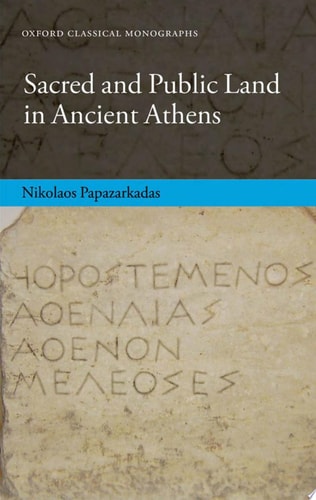
Landed wealth was crucial for the economies of all Greek city-states and, despite its peculiarities, Athens was no exception in that respect. This monograph is the first exhaustive treatment of sacred and public - in other words the non-private - real property in Athens. Following a survey of modern scholarship on the topic, Papazarkadas scrutinizes literary, epigraphic, and archaeological evidence in order to examine lands and other types of realty administered by the polis of Athens and its constitutional and semi-official subdivisions (such as tribes, demes, and religious associations). Contrary to earlier anachronistic models which saw sacred realty as a thinly disguised form of state property, the author perceives the sanctity of temene (sacred landholdings) as meaningful, both conceptually and economically. In particular, he detects a seamless link between sacred rentals and cultic activity. This link is markedly visible in two distinctive cases: the border area known as Sacred Orgas, a constant source of contention between Athens and Megara; and the moriai, Athena's sacred olive-trees, whose crop was the coveted prize of the Panathenaic games. Both topics are treated in separate appendices as are several other problems, not least the socio-economic profile of those involved in the leasing of sacred property, emerging from a detailed prosopographical analysis. However, certain non-private landholdings were secular and alienable, and their exploitation was often based on financial schemes different from those applied in the case of temene. This gives the author the opportunity to analyze and elucidate ancient notions of public and sacred ownership.
Menrva's Summary
THE THESIS
This monograph investigates the economic and conceptual distinctions between sacred and public landholdings in ancient Athens. Nikolaos Papazarkadas, a scholar of Greek epigraphy and history, utilizes a rigorous analysis of primary source material to challenge outdated models that conflated sacred property with state-owned land. By examining the administrative frameworks of the polis and its subdivisions, the author argues that the sanctity of landholdings held distinct economic and religious significance that influenced Athenian fiscal policy and cultic practice.
THE SCOPE MAP
What You Will Find
- A comprehensive survey of epigraphic, literary, and archaeological evidence regarding non-private Athenian real estate.
- Analysis of the administrative roles played by tribes, demes, and religious associations in land management.
- Detailed case studies on the Sacred Orgas border region and the management of Athena's sacred olive trees.
- A prosopographical analysis of the socio-economic profiles of individuals involved in leasing sacred property.
THE AUTHORITY PERSPECTIVE
Experts recognize this work as a foundational text for understanding the intersection of Athenian land tenure and religious administration. Scholars frequently note the technical density of the prose and the author's meticulous use of epigraphic data to reconstruct ancient economic systems.
Page Count:
416
Publication Date:
2011-12-17
Publisher:
Oxford University Press
ISBN-10:
0199694001
ISBN-13:
9780199694006
History
Economics
Archaeology
Ancient Greece
Community Tags
Similar Books