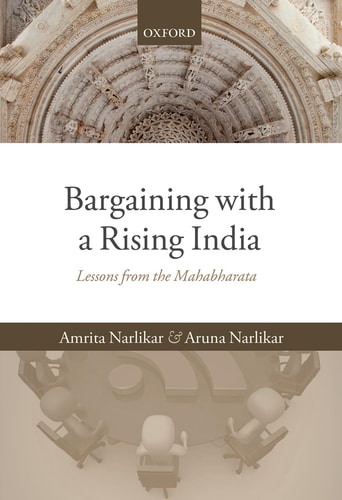
Bargaining with a Rising India: Lessons from the Mahabharata
0
0
As an Amazon Associate and affiliate partner, Menrva Books earns from qualifying purchases. Learn more
Author Description
The need to negotiate effectively with India is only growing as its power rises. Understanding the negotiating culture wherein India's bargaining behaviour is embedded forms a crucial step to facilitate this process. In the literature on international negotiation, experimental studies point to specific behavioural characteristics of Indian negotiators. Empirical analyses confirm these findings, and many suggest that the sources of India's negotiation behaviour are deep-rooted and culture-specific, going beyond what standard explanations of interest group politics, partisan politics, or institutional politics would suggest. But there are very few works that trace these sources. Extensive sociological and anthropological, and comparative political studies remain confined to their own fields, and do not develop their implications for Indian foreign policy or negotiation. There is a conspicuous lack of works that attempt to unpack the "negotiating culture" variable using literary sources. This book aims to fill both these gaps. It focuses on India's negotiating traditions through the lens of the classical Sanskrit text, the Mahabharata, and investigates the continuities and changes in India's negotiation behaviour as a rising power.
Menrva's Summary
THE THESIS
This book investigates how the classical Sanskrit epic, the Mahabharata, informs and shapes the contemporary negotiation strategies of a rising India. The authors, Amrita Narlikar and Aruna Narlikar, combine their expertise in international relations and sociology to bridge the gap between cultural studies and foreign policy. By analyzing the behavioral patterns depicted in the epic, they argue that India's modern diplomatic approach is deeply rooted in historical and cultural traditions that standard political science models often overlook.
THE SCOPE MAP
What You Will Find
- Analysis of negotiation behavior through the lens of the Mahabharata.
- Examination of the intersection between classical literature and modern foreign policy.
- Comparative study of historical negotiation tactics versus contemporary diplomatic practices.
- Identification of specific cultural variables that influence India's bargaining style.
THE AUTHORITY PERSPECTIVE
Experts in international relations and South Asian studies highlight this work as a unique interdisciplinary contribution that successfully integrates literary analysis with political science. Readers frequently note that the text provides a necessary cultural framework for understanding the complexities of Indian diplomacy in the global arena.
Page Count:
246
Publication Date:
2014-05-20
Publisher:
Oxford University Press
ISBN-10:
0199698384
ISBN-13:
9780199698387
History
Comparative Politics
International relations
Negotiation
Foreign Policy
India
Mahabharata
Community Tags
Similar Books