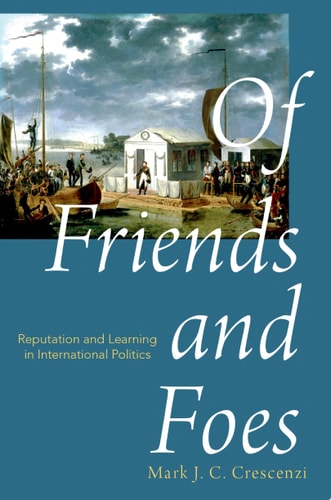
Of Friends and Foes: Reputation and Learning in International Politics
0
0
As an Amazon Associate and affiliate partner, Menrva Books earns from qualifying purchases. Learn more
Author Description
How do countries form reputations? Do these reputations affect interstate politics in the global arena? Reputations abound in world politics, but we know little about how state reputations form and how they evolve over time. We frequently use words like trust, credibility, resolve, integrity, risk, known commodity, and brand, to name a few, overlapping with reputation like a Venn diagram. As a result, the concept of reputation often gets stretched or diluted, weakening our ability to ascertain its role in cooperation and conflict.In this book, Crescenzi develops a theory of reputation dynamics to help identify when reputations form in ways that affect world politics, both in the realms of international conflict and cooperation. A reputation for honoring one's obligations in a treaty, for example, can make a state a more attractive ally. A reputation for war and conflict can trigger more of the same, leading to a cycle of violence that exacerbates security challenges. While these processes of cooperation and conflict seem distinct, they are linked by a common use of the information held in each state's reputation. In each case, states use reputational information in an attempt to resolve the uncertainty they face when crafting foreign policy decisions. With this theory in place, Crescenzi uses a blend of historical and empirical analysis to convince the reader that reputations do indeed matter in world politics. Moreover, we are able to identify patterns of reputation's influence in international relations. He demonstrates that over time and across the globe, reputations for conflict exacerbate crises while reputations for cooperation and reliability make future cooperation more likely.
Menrva's Summary
THE THESIS
How do state reputations form, and to what extent do these reputations influence interstate cooperation and conflict in the global arena? Mark J.C. Crescenzi, a scholar of international relations, addresses the conceptual ambiguity surrounding state reputation by proposing a formal theory of reputation dynamics. He argues that states utilize reputational information as a heuristic to mitigate uncertainty when making foreign policy decisions, effectively linking the mechanisms of conflict and cooperation through a shared informational framework.
THE SCOPE MAP
What You Will Find
- A theoretical framework for understanding reputation as an informational asset in international politics
- Analysis of how reputations for treaty compliance influence alliance formation
- Examination of how reputations for aggression perpetuate cycles of violence
- Empirical and historical case studies demonstrating the long-term impact of state behavior
Scope Limits
- The text focuses primarily on state-level actors rather than non-state organizations or individual leaders
- The analysis does not cover domestic political shifts that occur independently of international reputation
THE AUTHORITY PERSPECTIVE
Scholars in the field of international relations identify this work as a significant contribution to the study of signaling and uncertainty in foreign policy. Readers frequently note the academic density of the prose, which provides a rigorous analytical foundation for understanding state behavior.
Page Count:
208
Publication Date:
2018-01-01
Publisher:
Oxford University Press
ISBN-10:
0190609559
ISBN-13:
9780190609559
Diplomacy
Conflict Studies
Political Theory
International relations
Foreign Policy
Comparative Politics
Community Tags
Similar Books