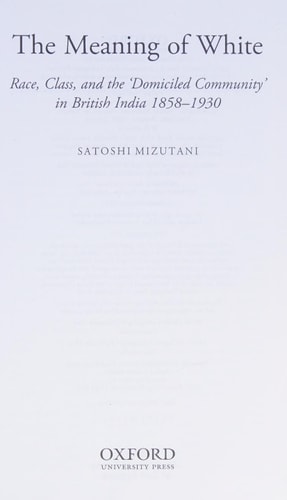
The Meaning of White: Race, Class, and the 'Domiciled Community' in British India 1858-1930
0
0
As an Amazon Associate and affiliate partner, Menrva Books earns from qualifying purchases. Learn more
Author Description
From 1858 to 1930 the concept of whiteness in British India was complex and contradictory. Under the Raj, the spread of racial ideologies was pervasive, but whiteness was never taken as self-evident. It was constantly called into question and its boundaries were disciplined and policed through socio-cultural and institutional practices.Only those whites with social status, cultural refinement, and the right level of education were able to command the respect and awe of colonized subjects. Among those who straddled the boundaries of whiteness were the 'domiciled community', made up of mixed-descent 'Eurasians' and racially unmixed 'Domiciled Europeans', both of whom lived in India on a permanent basis. Members of this community, or those who were categorized as such under the Raj, unwittingly rendered the meaning of whiteness ambiguous in fundamental ways.The colonial authorities quickly identified the domiciled community as a particularly malign source of political instability and social disorder, and were constantly urged to furnish various institutional measures - predominantly philanthropic and educational by character - that specifically targeted its degraded conditions. The Meaning of White reveals the precise ways in which the existence of this community was identified as a problem (the 'Eurasian Question') and examines the deeper historical meanings of this categorization. Dr Mizutani demystifies the ideology of whiteness, situating it within the concrete social realities of colonial history.
Menrva's Summary
THE THESIS
This work investigates how the concept of whiteness was constructed, contested, and policed within the socio-political framework of British India between 1858 and 1930. Satoshi Mizutani, a scholar of colonial history, utilizes archival records and administrative documents to analyze the 'Eurasian Question.' He argues that the existence of the 'domiciled community'—comprised of mixed-descent Eurasians and permanent Domiciled Europeans—challenged the colonial state's attempt to maintain a monolithic and superior racial identity. By examining institutional responses to this group, the author demonstrates that whiteness was not an inherent trait but a fragile status requiring constant social and cultural maintenance.
THE SCOPE MAP
What You Will Find
- Analysis of the 'Eurasian Question' and its impact on colonial administrative policy.
- Examination of the socio-cultural boundaries used to define and exclude members of the domiciled community.
- Evaluation of philanthropic and educational institutions designed to manage the perceived social disorder of the domiciled population.
- Historical investigation into the intersection of race, class, and residency status under the British Raj.
THE AUTHORITY PERSPECTIVE
Scholars of imperial history identify this monograph as a rigorous contribution to the study of racial ideology in colonial settings. Readers frequently note the academic density of the prose and the author's meticulous use of primary source evidence to deconstruct colonial power dynamics.
Page Count:
288
Publication Date:
2012-02-01
Publisher:
Oxford University Press
ISBN-10:
0199697701
ISBN-13:
9780199697700
History
Race Studies
British Empire
Sociology
Race Relations
Colonialism
India
Anglo-indians
Whites
Community Tags
Similar Books