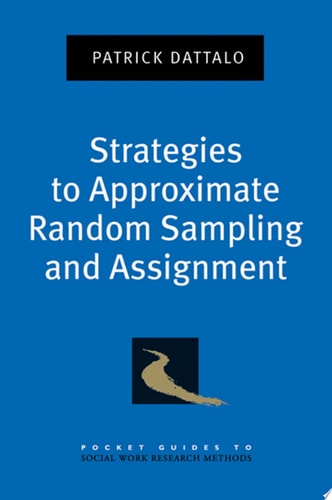
Strategies to Approximate Random Sampling and Assignment
0
0
As an Amazon Associate and affiliate partner, Menrva Books earns from qualifying purchases. Learn more
Author Description
Random sampling and random assignment are considered by many researchers to be the definitive methodological procedures for maximizing external and internal validity. However, there is a daunting list of legal, ethical, and practical barriers to implementing random sampling and random assignment. While there are no easy ways to overcome these barriers, social workers should seek and utilize strategies that minimize sampling and assignment bias. These methodological and statistical strategies form the book's core. In step-by-step chapters liberally illustrated with examples using a variety of software packages, Dattalo guides readers in selecting and implementing an appropriate strategy. Readers will gain confidence in using such techniques as exemplar sampling, sequential sampling, randomization tests, multiple imputation, mean-score logistic regression, partial randomization, constructed comparison groups, instrumental variables methods, and propensity scores. Each approach will be cataloged in such a way as to highlight its underlying assumptions, implementation strategies, and strengths and weaknesses. Screen shots, annotated resources, and a companion website make this a valuable tool for students, teachers, and researchers seeking a single source that provides a diverse set of tools that will maximize a study's validity when random sampling and random assignment are neither possible nor practical.
Menrva's Summary
THE THESIS
This book investigates how social work researchers can maintain study validity when traditional random sampling and assignment are hindered by ethical, legal, or practical constraints. Patrick Dattalo, an expert in social work research methods, provides a structured framework for navigating these methodological hurdles. He presents a variety of statistical and design-based strategies that allow researchers to minimize bias and improve the rigor of their studies in real-world settings.
THE SCOPE MAP
What You Will Find
- Methodological strategies including exemplar sampling, sequential sampling, and partial randomization.
- Statistical techniques such as multiple imputation, instrumental variables, and propensity scores.
- Step-by-step implementation guides featuring software examples and annotated resources.
- Comparative analysis of the underlying assumptions, strengths, and weaknesses of each approach.
THE AUTHORITY PERSPECTIVE
Experts and students frequently cite this text as a practical, accessible resource for navigating complex research design challenges in social work. The inclusion of software-specific examples and clear documentation makes it a highly functional reference for those conducting applied research.
Page Count:
216
Publication Date:
2009-01-01
Publisher:
Oxford University Press
ISBN-10:
0199702934
ISBN-13:
9780199702930
Methodology
Academic
Social Work
Research Methods
Statistics
Introduction to Social WorkWelfare