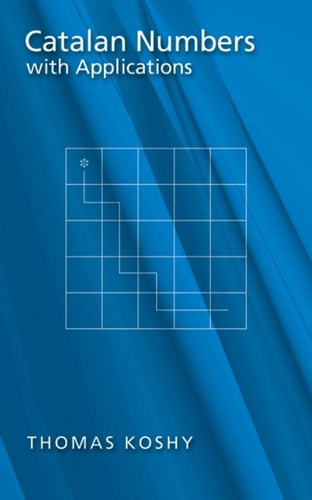
Catalan Numbers with Applications
0
0
As an Amazon Associate and affiliate partner, Menrva Books earns from qualifying purchases. Learn more
Author Description
Like the intriguing Fibonacci and Lucas numbers, Catalan numbers are also ubiquitous. "They have the same delightful propensity for popping up unexpectedly, particularly in combinatorial problems," Martin Gardner wrote in Scientific American. "Indeed, the Catalan sequence is probably the most frequently encountered sequence that is still obscure enough to cause mathematicians lacking access to Sloane's Handbook of Integer Sequences to expend inordinate amounts of energy re-discovering formulas that were worked out long ago," he continued. As Gardner noted, many mathematicians may know the abc's of Catalan sequence, but not many are familiar with the myriad of their unexpected occurrences, applications, and properties; they crop up in chess boards, computer programming, and even train tracks. This book presents a clear and comprehensive introduction to one of the truly fascinating topics in mathematics. Catalan numbers are named after the Belgian mathematician Eugene Charles Catalan (1814-1894), who "discovered" them in 1838, though he was not the first person to discover them. The great Swiss mathematician Leonhard Euler (1707-1763) "discovered" them around 1756, but even before then and though his work was not known to the outside world, Chinese mathematician Antu Ming (1692?-1763) first discovered Catalan numbers about 1730. Catalan numbers can be used by teachers and professors to generate excitement among students for exploration and intellectual curiosity and to sharpen a variety of mathematical skills and tools, such as pattern recognition, conjecturing, proof-techniques, and problem-solving techniques. This book is not only intended for mathematicians but for a much larger audience, including high school students, math and science teachers, computer scientists, and those amateurs with a modicum of mathematical curiosity. An invaluable resource book, it contains an intriguing array of applications to computer science, abstract algebra, combinatorics, geometry,
Menrva's Summary
THE THESIS
This book investigates the mathematical properties, historical origins, and diverse applications of the Catalan sequence. Author Thomas Koshy provides a comprehensive framework for understanding these numbers, drawing on historical records from mathematicians like Euler and Antu Ming to illustrate how these sequences function across various disciplines. The text serves as both an educational resource and a reference guide for students, educators, and professionals interested in the ubiquity of combinatorial patterns.
THE SCOPE MAP
What You Will Find
- Historical analysis of the discovery of Catalan numbers by Euler, Ming, and Catalan.
- Methodologies for pattern recognition, conjecturing, and formal proof techniques.
- Applications in computer programming, chess board configurations, and geometry.
- A collection of problems designed to sharpen analytical and problem-solving skills.
THE AUTHORITY PERSPECTIVE
Experts recognize this work as a thorough and accessible resource for those seeking to understand the breadth of combinatorial sequences. Readers frequently note the clarity of the explanations, which bridge the gap between academic theory and practical application for both students and professionals.
Page Count:
440
Publication Date:
2008-01-01
Publisher:
Oxford University Press
ISBN-10:
019971519X
ISBN-13:
9780199715190
Mathematics Statistics
Mathematics - General
Combinatorics
Mathematics
Number Theory
Reference
Computer Science
Community Tags
Other Editions(3)


Similar Books






Reader Comments
Share Your Thoughts
No comments yet. Be the first to share your thoughts!