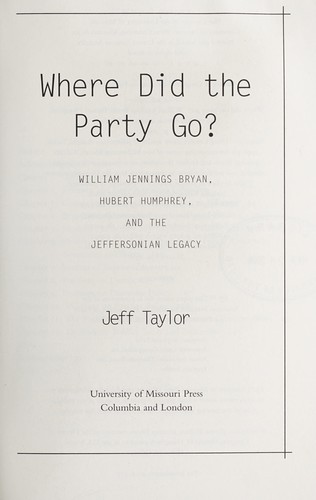
Where Did the Party Go?
0
0
As an Amazon Associate and affiliate partner, Menrva Books earns from qualifying purchases. Learn more
Author Description
Using a twelve-point model of Jeffersonian thought, Taylor appraises the competing views of two Midwestern liberals, William Jennings Bryan and Hubert Humphrey, on economic policy, foreign relations, and political reform to demonstrate how the Democratic party lost its place in Middle America--Provided by publisher.
Menrva's Summary
THE THESIS
This book investigates how the Democratic Party lost its connection with Middle America by examining the contrasting economic, foreign policy, and political reform views of William Jennings Bryan and Hubert Humphrey. The author, Jeff Taylor, utilizes a twelve-point model of Jeffersonian thought to appraise these competing perspectives. The analysis focuses on two prominent Midwestern liberals, demonstrating how their differing ideologies contributed to a shift in the party's base. This work provides a historical and analytical framework for understanding a significant period in American political history.
THE SCOPE MAP
- Analysis of William Jennings Bryan's views on economic policy, foreign relations, and political reform.
- Analysis of Hubert Humphrey's views on economic policy, foreign relations, and political reform.
- Application of a twelve-point model of Jeffersonian thought for appraisal.
- Comparative study of two Midwestern liberal Democrats.
- Exploration of the Democratic Party's perceived loss of connection with Middle America.
- Historical context of American political shifts in the 20th century.
THE AUTHORITY PERSPECTIVE
The book is positioned as a scholarly examination of American political history, likely appealing to academics and students of political science and history. Its focus on specific figures and a defined analytical model suggests a detailed and rigorous approach to the subject matter. The premise indicates a work that seeks to offer a nuanced understanding of partisan realignments. The analysis of competing ideologies within the Democratic party points to a text that will engage readers interested in the evolution of American political thought and electoral strategy.
Page Count:
373
Publication Date:
2006-01-01
ISBN-10:
0826216617
ISBN-13:
9780826216618
History
Art
Non-Fiction
American History
Political Reform
Community Tags
Similar Books