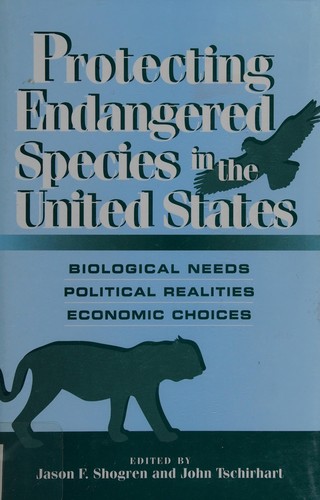
Protecting Endangered Species in the United States
0
0
As an Amazon Associate and affiliate partner, Menrva Books earns from qualifying purchases. Learn more
Author Description
This collection of original essays by economists, biologists and political scientists has a common theme: that protecting species at risk while safeguarding social order is a policy challenge that entangles biology, politics, and economics. Nearly 1200 species are now listed as endangered or threatened under the Endangered Species Act (ESA) of 1973; only twelve have been removed from the list. Attempts at species recovery on public and private property lead the authors to examine the political realities that define the debate: who should pay the costs and receive the benefits, and how interest group behavior affects the nature of endangered species protection. Although the ESA directs administrative agencies to list and protect species following scientific priorities, the collection addresses the economic choices that still must be confronted. These range from the protection potential of private markets to the design of incentive schemes to encourage conservation by private landowners
Menrva's Summary
THE THESIS
The Endangered Species Act (ESA) of 1973 faces significant challenges in effectively protecting at-risk species while maintaining societal order. This collection of essays explores the intricate entanglement of biology, politics, and economics in species protection policy. With nearly 1200 species listed and only a dozen successfully recovered, the authors investigate the political realities influencing conservation efforts on both public and private lands. The book examines crucial economic questions, including cost allocation, benefit distribution, and the impact of interest group behavior on policy outcomes, despite the ESA's directive for scientific priorities.
THE SCOPE MAP
- Analysis of the policy challenges in protecting endangered species while safeguarding social order.
- Examination of the interplay between biology, politics, and economics in conservation efforts.
- Discussion of the limited success of the Endangered Species Act (ESA) with only twelve species removed from the list.
- Investigation into the political realities that shape endangered species protection debates.
- Exploration of cost and benefit distribution in species recovery programs.
- Analysis of how interest group behavior influences conservation policy.
- Consideration of economic choices and market-based solutions for conservation.
- Examination of incentive schemes to encourage conservation by private landowners.
THE AUTHORITY PERSPECTIVE
This collection is regarded as a critical examination of the complexities inherent in species protection policy, particularly concerning the Endangered Species Act. The essays are noted for bringing together diverse perspectives from economists, biologists, and political scientists to address the policy challenges. The work highlights the economic and political factors that often complicate purely biological conservation goals. It is recognized for its in-depth analysis of who bears the costs and who reaps the benefits of conservation efforts.
Page Count:
401
Publication Date:
2001-01-01
ISBN-10:
0521662109
ISBN-13:
9780521662109
Nature
Science
Economics
Non-Fiction
Biology
Conservation
Community Tags
Similar Books