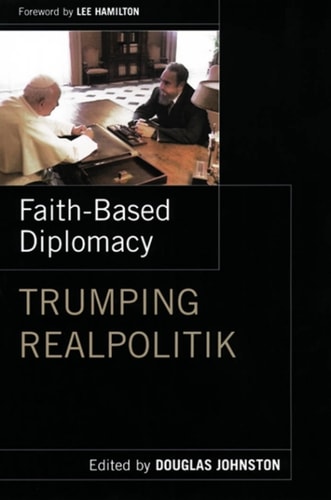
Faith-Based Diplomacy: Trumping Realpolitik
0
0
As an Amazon Associate and affiliate partner, Menrva Books earns from qualifying purchases. Learn more
Author Description
For most of the twentieth century, the most critical concerns of national security have been balance-of-power politics and the global arms race. The religious conflicts of this era and the motives behind them, however, demand a radical break with this tradition. If the United States is to prevail in its long-term contest with extremist Islam, it will need to re-examine old assumptions, expand the scope of its thinking to include religion and other "irrational" factors, and be willing to depart from past practice. A purely military response in reaction to such attacks will simply not suffice. What will be required is a long-term strategy of cultural engagement, backed by a deeper understanding of how others view the world and what is important to them. In non-Western cultures, religion is a primary motivation for political actions. Historically dismissed by Western policymakers as a divisive influence, religion in fact has significant potential for overcoming the obstacles that lead to paralysis and stalemate. The Incorporation of religion as part of the solution to such problems is as simple as it is profound. It is long overdue. This book looks at five intractable conflicts and explores the possibility of drawing on religion as a force for peace. It builds upon the insights of Religion, the Missing Dimension of Statecraft (OUP, 1994) -- which examined the role that religious or spiritual factors can play in preventing or resolving conflict -- while achieving social change based on justice and reconciliation. The world-class authors writing in this volume suggest how the peacemaking tenets of five major world religions can be strategically applied in ongoing conflicts in which those religions are involved. Finally, the commonalities and differences between these religions are examined with an eye toward further applications in peacemaking and conflict resolution.
Menrva's Summary
THE THESIS
Can religious frameworks be effectively integrated into modern statecraft to resolve intractable international conflicts that traditional realpolitik fails to address? Douglas Johnston, a recognized expert in the intersection of religion and international affairs, argues that Western policymakers must move beyond purely secular, military-focused strategies. By examining the role of spiritual and religious factors, the author posits that cultural engagement and faith-based diplomacy provide a necessary, long-term alternative to the limitations of traditional balance-of-power politics.
THE SCOPE MAP
What You Will Find
- Analysis of five distinct, intractable global conflicts where religious factors are central.
- A strategic framework for applying peacemaking tenets from five major world religions.
- Comparative study of commonalities and differences across religious traditions regarding conflict resolution.
- Evaluation of the historical failure of secular-only diplomacy in addressing extremist ideologies.
THE AUTHORITY PERSPECTIVE
Experts in international relations and peace studies view this work as a critical expansion of the discourse established in the author's previous foundational texts. Readers frequently note the academic rigor and the practical, policy-oriented approach the contributors take toward integrating faith into diplomatic strategy.
Page Count:
296
Publication Date:
2003-01-01
Publisher:
Oxford University Press
ISBN-10:
0199721955
ISBN-13:
9780199721955
History
Religion
Conflict Resolution
Religious Aspects
Diplomacy
International relations
Community Tags
Other Editions(2)
Similar Books




Reader Comments
Share Your Thoughts
No comments yet. Be the first to share your thoughts!