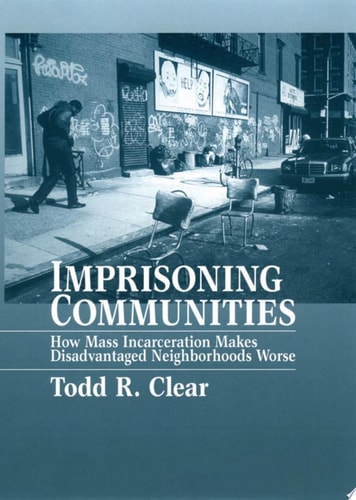
Imprisoning Communities
0
0
As an Amazon Associate and affiliate partner, Menrva Books earns from qualifying purchases. Learn more
Author Description
At No Time In History, And Certainly In No Other Democratic Society, Have Prisons Been Filled So Quickly And To Such Capacity Than In The United States. And Nowhere Has This Growth Been More Concentrated Than In The Disadvantaged--and Primarily Minority--neighborhoods Of America's Largest Urban Cities. In The Most Impoverished Places, As Much As 20% Of The Adult Men Are Locked Up On Any Given Day, And There Is Hardly A Family Without A Father, Son, Brother, Or Uncle Who Has Not Been Behind Bars. While The Effects Of Going To And Returning Home From Prison Are Well-documented, Little Attention Has Been Paid To The Impact Of Removal On Neighborhoods Where Large Numbers Of Individuals Have Been Imprisoned. In The First Detailed, Empirical Exploration Of The Effects Of Mass Incarceration On Poor Places, Imprisoning Communities Demonstrates That In High Doses Incarceration Contributes To The Very Social Problems It Is Intended To Solve: It Breaks Up Family And Social Networks; Deprives Siblings, Spouses, And Parents Of Emotional And Financial Support; And Threatens The Economic And Political Infrastructure Of Already Struggling Neighborhoods. Especially At Risk Are Children Who, Research Shows, Are More Likely To Commit A Crime If A Father Or Brother Has Been To Prison. Clear Makes The Counterintuitive Point That When Incarceration Concentrates At High Levels, Crime Rates Will Go Up. Removal, In Other Words, Has Exactly The Opposite Of Its Intended Effect: It Destabilizes The Community, Thus Further Reducing Public Safety. Demonstrating That The Current Incarceration Policy In Urban America Does More Harm Than Good, From Increasing Crime To Widening Racial Disparities And Diminished Life Chances For Youths, Todd Clear Argues That We Cannot Overcome The Problem Of Mass Incarceration Concentrated In Poor Places Without Incorporating An Idea Of Community Justice Into Our Failing Correctional And Criminal Justice Systems.
Menrva's Summary
THE THESIS
Does the high concentration of incarceration in specific urban neighborhoods actually exacerbate the social problems and crime rates it aims to mitigate? Todd R. Clear, a prominent scholar in criminology and criminal justice, utilizes empirical data to examine the systemic consequences of mass incarceration on impoverished, primarily minority, urban communities. He argues that when incarceration reaches a saturation point, it destabilizes the social and economic infrastructure of these neighborhoods, ultimately proving counterproductive to public safety goals.
THE SCOPE MAP
What You Will Find
- Empirical analysis of incarceration rates in disadvantaged urban neighborhoods.
- Examination of the breakdown of family and social networks due to mass removal.
- Assessment of the long-term impact on children and youth development in affected areas.
- A proposed framework for integrating community justice into existing correctional systems.
THE AUTHORITY PERSPECTIVE
Experts and sociologists frequently cite this work as a foundational text for understanding the unintended consequences of mass incarceration policies. Readers often note the academic rigor and the clarity with which Clear connects individual imprisonment to broader community destabilization.
Page Count:
280
Publication Date:
2009-01-01
Publisher:
Oxford University Press
ISBN-10:
0199728232
ISBN-13:
9780199728237
Social policy
Criminology
Public Policy
Sociology
Urban Studies
Community Tags
Similar Books