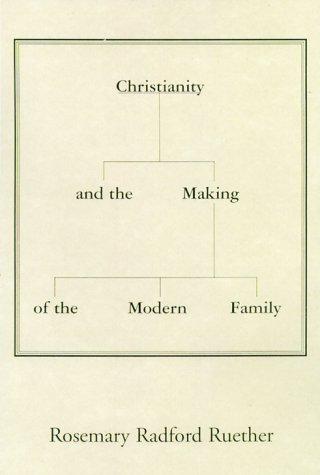
Christianity, Family, and the Rise of the West
0
0
As an Amazon Associate and affiliate partner, Menrva Books earns from qualifying purchases. Learn more
Author Description
Beginning with the Jewish and Roman families of antiquity, Ruether shows that the anti-family traditions of the Gospels and early Christianity can be understood as a critique of oppressive forms of family. But as the eschatological fervor of early Christianity waned, and the church grew into a stable social force, it came to rely upon family life, and soon sought to shape it. As Ruether traces the conjunctions between Christian theologies of family and political and economic change through patristic and medieval Christianity, the Reformation, and up to the present day, we see how religious and philosophical ideals have functioned again and again to prescribe, rather than describe, family roles. In particular, we see how these ideals have sought to tell women how to behave in relation to men.--BOOK JACKET.
Menrva's Summary
THE THESIS
This book investigates how Christian theology and the institution of the family have shaped Western societal structures and gender roles throughout history. Rosemary Radford Ruether, a renowned theologian and historian, examines the evolution of Christian thought on family, beginning with its critique of oppressive ancient family structures. She then traces how, as Christianity became a dominant social force, it increasingly prescribed family roles, particularly for women, in conjunction with political and economic changes from antiquity through the Reformation to the modern era.
THE SCOPE MAP
- Analysis of early Christian critiques of oppressive family structures in Jewish and Roman antiquity.
- Exploration of how Christian theology shifted from critique to prescription of family roles as the church grew.
- Tracing the conjunctions between Christian family theologies and political/economic changes through patristic and medieval Christianity.
- Examination of the Reformation's impact on Christian family ideals.
- Analysis of how religious and philosophical ideals have historically prescribed, rather than described, family roles.
- Focus on how Christian ideals have dictated women's behavior in relation to men across different historical periods.
- Contemporary analysis of the ongoing relationship between Christianity, family, and Western societal development.
THE AUTHORITY PERSPECTIVE
Rosemary Radford Ruether's work is recognized for its critical examination of the intersection between religion, gender, and social history. This book is noted for its deep historical analysis, tracing the complex relationship between Christian doctrines and the evolving concept of the family in the West. Scholars often cite Ruether's ability to connect theological developments with broader political and economic shifts, particularly highlighting her insights into the historical construction of gender roles within family structures. The book is considered a significant contribution to feminist theology and the history of Western social thought.
Page Count:
294
Publication Date:
2000-01-01
ISBN-10:
0807054046
ISBN-13:
9780807054048
History
Religion
Non-Fiction
Social History
Family Studies
Community Tags
Similar Books