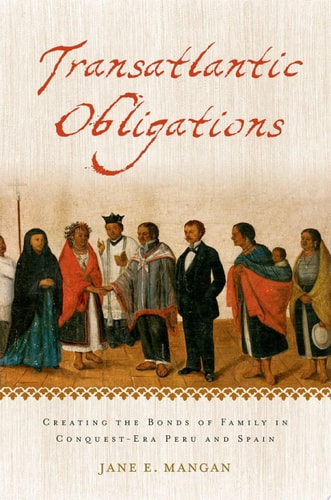
Transatlantic Obligations
0
0
As an Amazon Associate and affiliate partner, Menrva Books earns from qualifying purchases. Learn more
Author Description
The Sixteenth-century Changes Wrought By Expansion Of Spanish Empire Into Peru Shaped The Ways Of Being A Family In Colonial Peru. Even As Migration, Race Mixture, And Transculturation Took Place, Family Members Fulfilled Obligations To One Another By Adapting Custom To A Changing World. Family Began To Shift When, From The Moment Of Their Arrival In 1532, Spaniards Were Joined With Elite Indigenous Women In Political Marriage-like Alliances. Almost Immediately, A Generation Of Mestizos Was Born That Challenged The Hierarchies Of Colonial Society. In Response, The Spanish Crown Began To Promote The Marriage Of These Men And The Travel Of Spanish Women To Peru To Promote Good Customs And Even Serve As Surrogate Parents. Other Reactions Came From Wives In Spain Who, Abandoned By Husbands, Sought Assistance To Fulfill Family Duties. For Indigenous Families, The Pressures Of Colonialism Prompted Migration To Cities. By Mid-century, The Increase Of Spanish Migration To Peru Changed The Social Landscape, But Did Not Halt Mixed-race Marriages. The Book Posits That Late Sixteenth-century Cities, Specifically Lima And Arequipa, Were Host To Indigenous And Spanish Families But Also To Numerous 'blended' Families Borne Of A Process Of Mestizaje. In Its Final Chapter, The Legacies For The Next Generation Reveal How Spanish Fathers Sometimes Challenged Law With Custom And Sentiment To Establish Inheritance Plans For Their Children. By Tracing Family Obligations Connecting Peru And Spain Through Dowries, Bequests, Legal Powers, And Letters, Transatlantic Obligations Presents A Powerful Call To Rethink Sixteenth-century Definitions Of Family.
Menrva's Summary
THE THESIS
This work investigates how the expansion of the Spanish Empire into sixteenth-century Peru fundamentally altered the structure and function of family life through migration, transculturation, and legal adaptation. Jane E. Mangan, a historian specializing in colonial Latin America, utilizes archival records, legal documents, and personal correspondence to argue that family obligations were not static but were actively negotiated across the Atlantic. She demonstrates that despite rigid colonial hierarchies, individuals consistently prioritized familial duties by blending Spanish customs with indigenous practices to navigate a rapidly changing social landscape.
THE SCOPE MAP
What You Will Find
- Analysis of sixteenth-century social shifts in Lima and Arequipa.
- Examination of legal mechanisms including dowries, bequests, and letters of power.
- Documentation of the rise of mestizo populations and their impact on colonial social structures.
Scope Limits
- The study focuses primarily on the sixteenth century and does not extend into the later colonial periods.
- The research is concentrated on specific urban centers and does not provide an exhaustive account of rural indigenous family life.
THE AUTHORITY PERSPECTIVE
Historians and scholars of colonial Latin America recognize this text as a significant contribution to the study of social history and the evolution of the family unit under imperial pressure. Readers frequently note the meticulous use of primary source documentation to challenge traditional narratives regarding colonial marriage and inheritance laws.
Page Count:
320
Publication Date:
2015-01-01
Publisher:
Oxford University Press
ISBN-10:
0190456116
ISBN-13:
9780190456115
History
Family Studies
Colonial History
Social History
American History
Peru
Community Tags
Similar Books