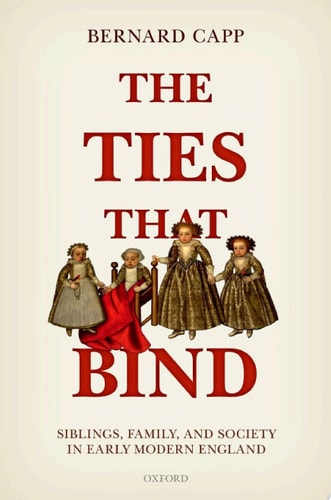
The Ties That Bind: Siblings, Family, and Society in Early Modern England
0
0
As an Amazon Associate and affiliate partner, Menrva Books earns from qualifying purchases. Learn more
Author Description
The family is a major area of scholarly research and public debate. Many studies have explored the English family in the sixteenth and seventeenth centuries, focusing on husbands and wives, parents and children. The Ties that Bind explores in depth the other key dimension: the place of brothers and sisters in family life, and in society. Moralists urged mutual love and support between siblings, but recognized that sibling rivalry was a common and potent force. The widespread practice of primogeniture made England distinctive. The eldest son inherited most of the estate and with it, a moral obligation to advance the welfare of his brothers and sisters. The Ties that Bind explores how this operated in practice, and shows how the resentment of younger brothers and sisters made sibling relationships a heated issue in this period, in family life, in print, and also on the stage.
Menrva's Summary
THE THESIS
This work investigates the critical role of sibling relationships in shaping family dynamics, social structures, and cultural expectations in sixteenth and seventeenth-century England. Bernard Capp, a distinguished historian of early modern England, utilizes a wide array of primary sources—including personal correspondence, legal records, and contemporary literature—to challenge the traditional focus on parent-child and marital bonds. He argues that the tension between moral ideals of sibling solidarity and the practical realities of primogeniture created a distinct social friction that influenced everything from inheritance disputes to theatrical representations.
THE SCOPE MAP
What You Will Find
- Analysis of the impact of primogeniture on sibling welfare and family hierarchy.
- Examination of sibling rivalry as a recurring theme in early modern literature and drama.
- Investigation into the moral and religious expectations placed upon brothers and sisters.
- Use of personal letters, diaries, and legal records to reconstruct domestic life.
Scope Limits
- The study is geographically restricted to England during the sixteenth and seventeenth centuries.
- It does not focus on the broader European context of family law or inheritance practices.
THE AUTHORITY PERSPECTIVE
Scholars frequently cite this text as a foundational study for understanding the complexities of kinship beyond the nuclear family unit. Experts highlight the author's ability to synthesize archival research with cultural analysis to provide a nuanced view of early modern social life.
Page Count:
240
Publication Date:
2018-01-01
Publisher:
OUP Oxford
ISBN-10:
0192556355
ISBN-13:
9780192556356
History
Social History
Siblings
Great Britain
Sociology
Family Studies
Early Modern
European History
Cultural History
Community Tags
Similar Books