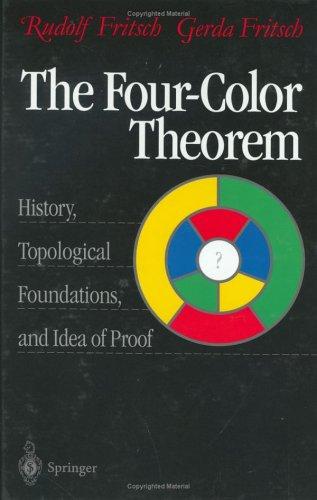
The Four Color Theorem
0
0
As an Amazon Associate and affiliate partner, Menrva Books earns from qualifying purchases. Learn more
Author Description
This elegant little book discusses a famous problem that helped to define the field now known as graph theory: what is the minimum number of colors required to print a map such that no two adjoining countries have the same color, no matter how convoluted their boundaries are. Many famous mathematicians have worked on the problem, but the proof eluded formulation until the 1970s, when it was finally cracked with a brute-force approach using a computer. The Four-Color Theorem begins by discussing the history of the problem up to the new approach given in the 1990s (by Neil Robertson, Daniel Sanders, Paul Seymour, and Robin Thomas). The book then goes into the mathematics, with a detailed discussion of how to convert the originally topological problem into a combinatorial one that is both elementary enough that anyone with a basic knowledge of geometry can follow it and also rigorous enough that a mathematician can read it with satisfaction. The authors discuss the mathematics and point to the philosophical debate that ensued when the proof was announced: just what is a mathematical proof, if it takes a computer to provide one - and is such a thing a proof at all?
Menrva's Summary
THE THESIS
The Four-Color Theorem investigates the minimum number of colors needed to map any geographical area without adjacent regions sharing a hue. The book traces the historical pursuit of this problem, a challenge that significantly shaped the field of graph theory. It details the eventual proof, achieved in the 1970s through a computer-assisted, brute-force method, and discusses the subsequent philosophical debate regarding the nature of mathematical proof when computers are involved. The authors present the mathematical conversion of the topological problem into a combinatorial one, aiming for accessibility to those with basic geometry knowledge while maintaining rigor for mathematicians.
THE SCOPE MAP
- History of the Four-Color Theorem problem up to the 1990s.
- Detailed discussion of the computer-assisted proof by Neil Robertson, Daniel Sanders, Paul Seymour, and Robin Thomas.
- Conversion of the topological problem into a combinatorial one.
- Mathematical exposition accessible to those with basic geometry knowledge.
- Rigorous mathematical treatment for professional mathematicians.
- Exploration of the philosophical debate surrounding computer-aided proofs.
- The role of the problem in defining graph theory.
THE AUTHORITY PERSPECTIVE
The book is recognized for its elegant approach to a famous mathematical problem that was instrumental in defining graph theory. It presents the historical context and the eventual computer-assisted proof in a manner accessible to those with a basic geometry background, while still offering mathematical rigor. The text also engages with the significant philosophical questions raised by computer-aided proofs, prompting reflection on the definition of mathematical proof itself. This work serves as a thorough yet approachable examination of the Four-Color Theorem and its implications.
Page Count:
260
Publication Date:
1998-01-01
ISBN-10:
0387984976
ISBN-13:
9780387984971
Non-Fiction
History
Science
Mathematics
Combinatorics
Graph Theory
Community Tags
Similar Books