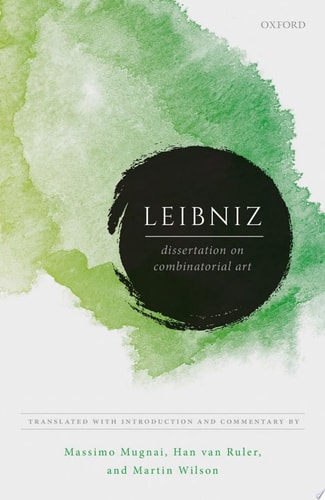
Leibniz: Dissertation on the Combinatorial Art
0
0
As an Amazon Associate and affiliate partner, Menrva Books earns from qualifying purchases. Learn more
Author Description
Intro -- Halftitle Page -- Series Page -- Title Page -- Copyright Page -- Preface -- On This Edition -- Quotation Marks -- References -- Abbreviations -- Contents -- Introduction -- 1 The Project For The 'characteristic Art' -- 2 'lullism' In The Seventeenth Century: Art Of Memory And First Steps Towards The Creation Of An Encyclopedia -- 3 The Project For The Creation Of A Universal Language -- 4 Atomism And 'immeation' -- 5 Themes From The Dac In Leibniz's Mature Philosophy -- 6 The First Two Problems And Their Solutions -- 7 The 'application' (usus) To Traditional Syllogistic 8 Singular Propositions And Some Syllogistic Rules -- 9 A Classification Of Syllogistic Moods -- 10 Useful And Useless, Valid And Invalid Moods. A General Method For Finding A Counterexample -- 11 The Influence Of Wirth (hospinianus), Pierre De La Ramée, And Thomasius -- 12 Using Numbers To Encode Concepts (and Propositions) -- 13 Finding All Possible Subjects And Predicates -- 14 Finding The Number Of All Valid Syllogistic Arguments Having A Given Proposition As Conclusion -- 15 Some Problems Concerning Variations (permutations). The 'head' Of A Set Of Variations -- 16 Atomism And Mereology A Dissertation On Combinatorial Art -- Text And Translation 1 -- Synopsis Dissertationis De Arte Combinatoria. -- Demonstratio Existentiae Dei. -- [1] Cum Deo! -- Definitiones -- Problemata. -- Probl. I. Dato Numero Et Exponente Complexiones Invenire. -- Probl. Ii. Dato Numero Complexiones Simpliciter Invenire. -- Probl. Iii. Dato Numero Classium Et Rerum In Classibus Complexiones Classium Invenire. -- Probl. Iv. Dato Numero Rerum Variationes Ordinis Invenire. -- Christus -- Probl. V. Dato Numero Rerum Variationem Situs Mere Relati Seu Vicinitatis Invenire. Probl. Vi. Dato Numero Rerum Variandarum, Quarum Aliqva Vel Aliquae Repetuntur, Variationem Ordinis Invenire. -- [69] Probl. Vii. Dato Capite Variationes Reperire. -- Probl. Viii. Variationes Alteri Dato Capiti Communes Reperire. -- Probl. Ix. Capita
Menrva's Summary
THE THESIS
This work investigates the foundational question of whether human knowledge can be systematized through a universal logical calculus based on combinatorial principles. Gottfried Wilhelm Leibniz, writing as a young scholar, proposes that complex ideas can be decomposed into simple, atomic concepts, which are then manipulated through mathematical operations to generate all possible truths. The text serves as an early attempt to formalize logic into a symbolic system, bridging the gap between traditional syllogistic reasoning and modern computational theory.
THE SCOPE MAP
What You Will Find
- A systematic classification of syllogistic moods and logical validity.
- Mathematical methods for calculating permutations and combinations of concepts.
- An exploration of the 'characteristic art' as a precursor to a universal language.
- The application of numerical encoding to represent logical propositions.
Scope Limits
- The text does not provide a fully realized universal language, remaining a theoretical framework rather than a complete lexicon.
- It does not address the later metaphysical developments of Leibniz's mature philosophy in depth.
THE AUTHORITY PERSPECTIVE
Scholars identify this text as a critical document for understanding the early development of Leibniz's logical project and his influence on modern symbolic logic. Readers frequently note the technical density of the mathematical proofs and the historical context required to fully grasp the author's departure from Aristotelian tradition.
Page Count:
240
Publication Date:
2020-01-01
Publisher:
Oxford University Press,
ISBN-10:
0192575104
ISBN-13:
9780192575104
Philosophy
Logic
Epistemology
Science History
Combinatorics
Mathematics
Community Tags
Similar Books