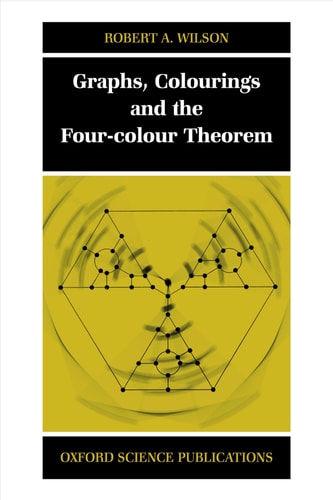
Graphs, Colourings and the Four-Colour Theorem
0
0
As an Amazon Associate and affiliate partner, Menrva Books earns from qualifying purchases. Learn more
Author Description
The Four-colour Theorem is one of the famous problems of mathematics, that frustrated generations of mathematicians from its birth in 1852 to its solution (using substantial assistance from electronic computers) in 1976. The theorem asks whether four colours are sufficient to colour all conceivable maps, in such a way that countries with a common border are coloured with different colours. The book discusses various attempts to solve this problem, and some of the mathematics which developed out of these attempts. Much of this mathematics has developed a life of its own, and forms a fascinating part of the subject now known as graph theory. The book is designed to be self-contained, and develops all the graph-theoretical tools needed as it goes along. It includes all the elementary graph theory that should be included in an introduction to the subject, before concentrating on specific topics relevant to the Four-colour problem. Part I covers basic graph theory, Euler's polyhedral formula, and the first published false 'proof' of the Four-colour theorem. Part II ranges widely through related topics, including map-colouring on surfaces with holes, the famous theorems of Kuratowski, Vizing, and Brooks, the conjectures of Hadwiger and Hajos, and much more besides. In Part III we return to the Four-colour theorem, and study in detail the methods which finally cracked the problem.
Menrva's Summary
THE THESIS
This text investigates the historical development and eventual proof of the Four-colour Theorem, a central problem in graph theory. Robert A. Wilson, a mathematician, provides a structured examination of the theorem's origins in 1852 and its eventual resolution in 1976. The book utilizes a pedagogical framework to introduce foundational graph-theoretical concepts before transitioning into the complex methodologies required to solve the map-colouring problem.
THE SCOPE MAP
What You Will Find
- Comprehensive introduction to basic graph theory and Euler's polyhedral formula
- Analysis of historical attempts and false proofs of the Four-colour Theorem
- Exploration of map-colouring on surfaces with holes and related theorems by Kuratowski, Vizing, and Brooks
- Detailed study of the computational methods used in the 1976 solution
Scope Limits
- Does not provide an exhaustive history of all branches of modern mathematics
- Focuses primarily on graph theory rather than general topology or broader computational complexity theory
THE AUTHORITY PERSPECTIVE
Readers frequently note the self-contained nature of the text, which makes it accessible for students beginning their study of graph theory. Experts highlight this as a clear and logical resource for understanding both the elementary principles and the specific technical hurdles of the Four-colour Theorem.
Page Count:
150
Publication Date:
2002-01-01
Publisher:
Oup Oxford
ISBN-10:
019158360X
ISBN-13:
9780191583605
Mathematics
Combinatorics
Academic
Graph Theory
textbook