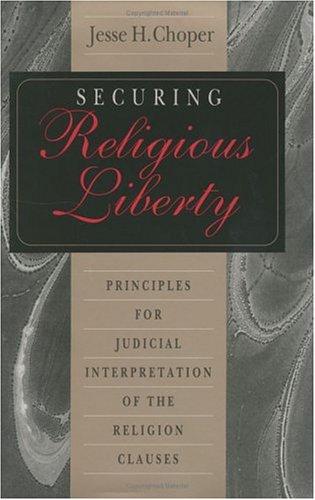
Securing Religious Liberty
0
0
As an Amazon Associate and affiliate partner, Menrva Books earns from qualifying purchases. Learn more
Author Description
Although the Constitution states that there shall be no laws that either establish or prohibit religion, the application of the Religion Clauses throughout United States history has been fraught with conflict and ambiguity. In this book, a leading constitutional scholar proposes a set of guidelines meant to provide for the consistent application of the First Amendment's Religion Clauses. Choper's guidelines are designed to provide maximum protection for religious freedom without granting anyone an advantage, inflicting a disadvantage, or causing an unfair burden. Though not calling for the wholesale overturning of judicial precedents or established social practices, the standards he proposes would result in significant - and controversial - modifications to existing doctrines and customs. Choper argues, for instance, that though vocal prayer and Bible reading in public schools should continue to be prohibited, we can and should allow for silent prayer and objective courses in creation science. His standards would also, among other things, eliminate the tax exemption on property used exclusively for religious purposes while allowing parochial schools to receive public funds for the nonreligious component of their education.
Menrva's Summary
THE THESIS
The book proposes a new framework for interpreting and applying the First Amendment's Religion Clauses to ensure consistent protection of religious liberty. Jesse H. Choper, a distinguished constitutional scholar, addresses the historical conflicts and ambiguities surrounding the Establishment and Free Exercise Clauses. He offers a set of guidelines aimed at maximizing religious freedom by preventing laws that grant advantages, inflict disadvantages, or impose unfair burdens on religious practice. While not advocating for a complete overhaul of existing legal precedents or societal norms, Choper's proposed standards would lead to significant changes in current doctrines and customs.
THE SCOPE MAP
- A critical analysis of historical applications of the First Amendment's Religion Clauses.
- A proposed set of guidelines for consistent application of the Establishment and Free Exercise Clauses.
- Arguments for allowing silent prayer and objective courses in creation science in public schools.
- Proposals to eliminate property tax exemptions for exclusively religious use.
- Considerations for allowing public funds for the non-religious components of parochial school education.
- Discussion of significant modifications to existing legal doctrines and social practices concerning religion.
THE AUTHORITY PERSPECTIVE
The book is regarded as a significant, albeit controversial, contribution to the legal and philosophical discourse on religious liberty in the United States. Choper's proposals, such as allowing silent prayer in schools while prohibiting vocal prayer, and his stance on tax exemptions for religious property, are noted for their potential to reshape established legal interpretations and societal practices. The work is recognized for its scholarly rigor and its attempt to provide a coherent framework for a complex constitutional issue. Its arguments are likely to provoke debate among legal scholars, policymakers, and religious communities.
Page Count:
198
Publication Date:
1995-01-01
ISBN-10:
0226104451
Non-Fiction
Religion
Politics
Law
American History
Community Tags
Similar Books