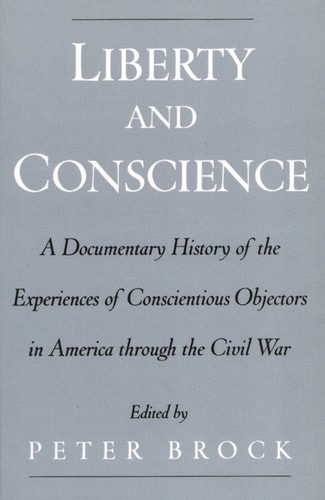
Liberty and Conscience: A Documentary History of the Experiences of Conscientious Objectors in America through the Civil War
0
0
As an Amazon Associate and affiliate partner, Menrva Books earns from qualifying purchases. Learn more
Author Description
Although the act of conscientious objection entered modern consciousness most strikingly as a result of the Vietnam War, Americans have long struggled to reconcile their politics, pacifist beliefs, and compulsory military service. While conscientious objection in the twentieth century has been well documented, there has been surprisingly little study of its long history in America's early conflicts, defined as these have been by accounts of patriotism and nation-building. In fact, during the period of conscription from the late 1650s to the end of the Civil War, many North Americans refused military service on grounds of conscience.In this volume, Peter Brock, one of the foremost historians of American pacifism, seeks to remedy this oversight by presenting a rich and varied collection of documents, many drawn from obscure sources, that shed new light on American religious and military history. These include legal findings, church and meeting proceedings, appeals by nonconformists to government authorities, and illuminating excerpts from personal journals. These accounts contain many poignant, often painful, and sometimes even humorous episodes that offer glimpses into the lives of conscientious objectors of the era. One of the most striking features to emerge from these documents is the critical role of religion in the history of American pacifism. Brock finds that virtually all who refused military service in this period were inspired by religious convictions, with Quakers frequently the most ardent dissenters. In the antebellum period, however, the pacifist spectrum expanded to include nonsectarians such as the famous abolitionist William Lloyd Garrison, founder of the New England Non-Resistance Society. A dramatic, powerful portrait of early American pacifism, Liberty and Conscience presents not only the thought and practice of the objectors themselves, but also the response of the authorities and the general public.
Menrva's Summary
THE THESIS
This volume investigates the historical roots and religious foundations of conscientious objection in America from the colonial era through the Civil War. Peter Brock, a distinguished historian of pacifism, compiles a diverse array of primary source documents to challenge the perception that conscientious objection is a modern phenomenon. By analyzing legal records, personal journals, and church proceedings, the author argues that religious conviction served as the primary driver for those refusing military service long before the twentieth century.
THE SCOPE MAP
What You Will Find
- A chronological collection of primary source documents spanning the 1650s to the 1865 conclusion of the Civil War.
- Legal findings, government appeals, and meeting proceedings regarding military conscription.
- Analysis of the transition from sectarian religious pacifism to the inclusion of nonsectarian abolitionist perspectives.
Scope Limits
- The text focuses primarily on the period ending with the American Civil War and does not provide extensive coverage of twentieth-century conflicts.
- The analysis is limited to the North American context and does not compare these findings to global pacifist movements.
THE AUTHORITY PERSPECTIVE
Historians and scholars of American religious history recognize this work as a foundational resource for understanding the early development of pacifist dissent. Readers frequently note the academic rigor of the document selection, which provides a necessary corrective to narratives that overlook the long history of non-participation in American military conflicts.
Page Count:
206
Publication Date:
2002-01-01
Publisher:
Oxford University Press
ISBN-10:
0190287977
ISBN-13:
9780190287979
Religion
History
United States
American History
Photography
Humanities
Special Topics
Pacifism
Military History
Civil War
Community Tags
Other Editions(2)

Similar Books





Reader Comments
Share Your Thoughts
No comments yet. Be the first to share your thoughts!