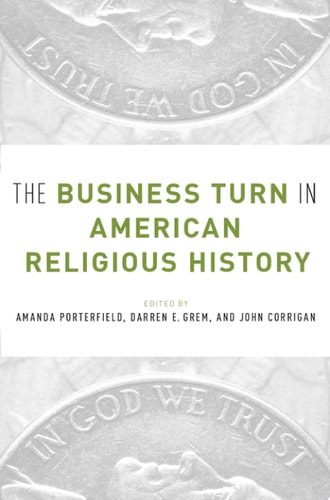
The Business Turn in American Religious History
0
0
As an Amazon Associate and affiliate partner, Menrva Books earns from qualifying purchases. Learn more
Author Description
Business has received little attention in American religious history, although it has profound implications for understanding the sustained popularity and ongoing transformation of religion in the United States. This volume offers a wide ranging exploration of the business aspects of American religious organizations. The authors analyze the financing, production, marketing, and distribution of religious goods and services and the role of wealth and economic organization in sustaining and even shaping worship, charity, philanthropy, institutional growth, and missionary work. Treating religion and business holistically, their essays show that American religious life has always been informed by business practices. Laying the groundwork for further investigation, the authors show how American business has functioned as a domain for achieving religious goals. Indeed they find that religion has historically been more powerful when interwoven with business.Chapters on Mormon enterprise, Jewish philanthropy, Hindu gurus, Native American casinos, and the wedding of business wealth to conservative Catholic social teaching demonstrate the range of new studies stimulated by the business turn in American religious history. Other chapters show how evangelicals joined neo-liberal economic practice and right-wing politics to religious fundamentalism to consolidate wealth and power, and how they developed marketing campaigns and organizational strategies that transformed the American religious landscape. Included are essays exposing the moral compromises religious organizations have made to succeed as centers of wealth and influence, and the religious beliefs that rationalize and justify these compromises. Still others examine the application of business practices as a means of sustaining religious institutions and expanding their reach, and look at controversies over business practices within religious organizations, and the adjustments such organizations have made in response.
Menrva's Summary
THE THESIS
This volume investigates the historical intersection of American religious institutions and business practices to determine how economic strategies have shaped the development and sustainability of faith-based organizations. The authors, including John Corrigan, Darren E. Grem, and Amanda Porterfield, utilize a collection of scholarly essays to argue that religious life in the United States has consistently operated through the mechanisms of financing, marketing, and organizational management. By examining these intersections, the contributors demonstrate that religious influence is often amplified when integrated with commercial structures and wealth-building activities.
THE SCOPE MAP
What You Will Find
- Analysis of religious financing, production, and distribution models.
- Case studies covering Mormon enterprise, Jewish philanthropy, Hindu gurus, and Native American casinos.
- Examination of the synthesis between evangelical fundamentalism and neo-liberal economic practices.
- Discussions on the moral compromises inherent in institutional wealth accumulation.
Scope Limits
- The text does not provide a comprehensive history of every American religious denomination.
- It does not offer a prescriptive guide for modern religious fundraising or management.
THE AUTHORITY PERSPECTIVE
Scholars and historians identify this volume as a foundational text for understanding the material culture of American religion. Readers frequently note the academic density of the prose and the breadth of the case studies provided.
Page Count:
261
Publication Date:
2017-01-01
Publisher:
Oxford University Press
ISBN-10:
0190694599
ISBN-13:
9780190694593
Economics
History
Religion
American Studies
United States
Business Aspects
Sociology of Religion
American History
Community Tags
Similar Books








Reader Comments
Share Your Thoughts
No comments yet. Be the first to share your thoughts!