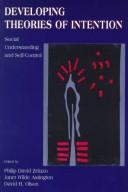
Developing Theories of Intention
0
0
As an Amazon Associate and affiliate partner, Menrva Books earns from qualifying purchases. Learn more
Author Description
In this book, leading scholars address difficult but fascinating questions concerning intentionality as it is manifested in a wide variety of contexts, including imitation in infancy, early understanding of mental states, reasoning in nonhuman primates, executive function, language acquisition, and narrative understanding. Collectively, the contributors demonstrate that intentionality is a key issue in the cognitive and social sciences. Moreover, in a way that was anticipated more than a century ago by the seminal work of J. Mark Baldwin, they are beginning to reveal how the control of action is related in development to children's emerging self-consciousness and their increasingly sophisticated appreciation of other people's perspectives.
Menrva's Summary
THE THESIS
This book investigates the complex nature of intentionality across various developmental and cognitive contexts. The contributors, leading scholars in their fields, explore how intentionality is demonstrated in imitation, early mental state understanding, primate reasoning, executive function, language acquisition, and narrative comprehension. They highlight intentionality as a crucial concept in the cognitive and social sciences, drawing parallels to J. Mark Baldwin's early work on the control of action and its developmental link to self-consciousness and the understanding of others' perspectives.
THE SCOPE MAP
- Exploration of intentionality in imitation and early infant behavior.
- Analysis of children's emerging understanding of mental states.
- Examination of reasoning capabilities in nonhuman primates.
- Discussion of the role of intentionality in executive function.
- Investigation into the relationship between intentionality and language acquisition.
- Consideration of intentionality in narrative understanding.
- Connection between the control of action, self-consciousness, and perspective-taking.
THE AUTHORITY PERSPECTIVE
This collection of essays is recognized for its rigorous examination of intentionality, a fundamental concept in the cognitive and social sciences. The contributors, all leading scholars, offer diverse perspectives on how intentionality manifests across different domains, from infant imitation to primate cognition and language development. The book is noted for its synthesis of developmental psychology and philosophy of mind, particularly its engagement with historical perspectives like J. Mark Baldwin's work. The collective effort aims to demonstrate the centrality of intentionality in understanding human and animal cognition.
Page Count:
368
Publication Date:
1999-01-01
ISBN-10:
0805831428
ISBN-13:
9780805831429
Non-Fiction
Psychology
Neuroscience
Developmental Psychology
Community Tags
Similar Books