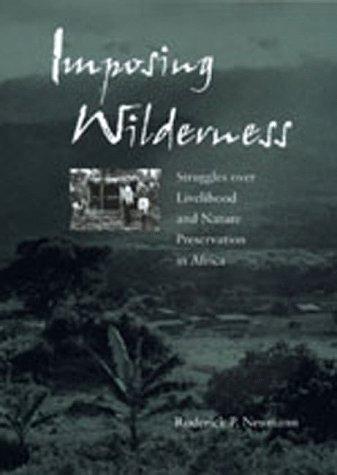
Imposing Wilderness
0
0
As an Amazon Associate and affiliate partner, Menrva Books earns from qualifying purchases. Learn more
Author Description
Arusha National Park in northern Tanzania, known for its scenic beauty, embodies in microcosm all the political-ecological dilemmas facing protected areas throughout Africa: it is, in part, a battle ground. The roots of the ongoing struggle between the park on Mount Meru and the neighboring Meru peasant communities go much deeper, in Roderick Neumann's illuminating analysis, than the issues of poverty, population growth, and ignorance usually cited. The conflicts regularly erupting there and elsewhere reflect differences that go back to the beginning of colonial rule. By imposing a European ideal of pristine wilderness, Neumann says, the establishment of national parks and protected areas displaced African meanings as well as material access to the land. The book focuses on the symbolic importance of natural landscapes among various social groups in this setting, and how it relates to conflicts between peasant communities and the state. Neumann's thoughtful framing of the issues that fuel ongoing controversies will interest ecologists as well as those interested in political economy and development in Africa.
Menrva's Summary
THE THESIS
This book investigates the deep-rooted conflicts between protected areas and local communities in Africa, arguing that contemporary struggles are shaped by colonial legacies. Roderick P. Neumann, an expert in political ecology, analyzes Arusha National Park in Tanzania as a microcosm of these broader issues. He posits that the imposition of a European ideal of pristine wilderness during colonial rule displaced African meanings and access to land, creating ongoing tensions. The book explores the symbolic importance of natural landscapes and their relation to conflicts between peasant communities and the state.
THE SCOPE MAP
- An analysis of Arusha National Park as a case study for African protected areas.
- Exploration of the historical roots of conflict tracing back to colonial rule.
- Examination of the imposition of European wilderness ideals and their impact on local communities.
- Discussion of the symbolic importance of natural landscapes in peasant-state conflicts.
- Insights into the political-ecological dilemmas facing protected areas across Africa.
THE AUTHORITY PERSPECTIVE
The book is recognized for its illuminating analysis of the political-ecological dilemmas facing protected areas in Africa. Neumann's thoughtful framing of issues that fuel ongoing controversies is noted as particularly valuable for ecologists and those interested in African political economy and development. The work is appreciated for tracing contemporary conflicts back to the colonial era's imposition of European wilderness ideals. It offers a nuanced perspective on how these historical actions continue to shape land access and meaning for local communities.
Page Count:
256
Publication Date:
1998-01-01
ISBN-10:
0520211782
Nature
History
Non-Fiction
Politics
Environmental History
Conservation
Community Tags
Similar Books