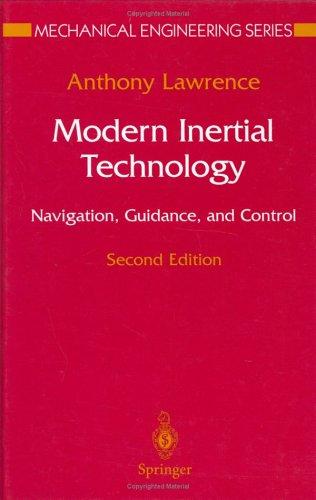
Modern Inertial Technology
0
0
As an Amazon Associate and affiliate partner, Menrva Books earns from qualifying purchases. Learn more
Author Description
This book describes the inertial technology used for guidance, control, and navigation, discussing in detail the principles, operation, and design of inertial sensors - gyroscopes and accelerometers - as well as the advantages and disadvantages of particular systems. An engineer with long practical experience in the field, the author elucidates the most recent developments in inertial guidance. Among these are fiber-optic gyroscopes, solid-state accelerometers, and the Global Positioning System. The book should be of interest to researchers and practicing engineers involved in systems engineering, aeronautics, space research, and navigation on land and on sea.
Menrva's Summary
THE THESIS
This book details the core principles and recent advancements in inertial technology for guidance, control, and navigation. The author, an experienced engineer, provides an in-depth examination of inertial sensors, specifically gyroscopes and accelerometers, covering their fundamental operation and design considerations. It also evaluates the strengths and weaknesses inherent in various inertial systems, offering insights into their practical application across diverse fields.
THE SCOPE MAP
- Principles of inertial guidance, control, and navigation.
- Detailed discussion of gyroscope operation and design.
- Detailed discussion of accelerometer operation and design.
- Advantages and disadvantages of different inertial systems.
- Recent developments including fiber-optic gyroscopes.
- Recent developments including solid-state accelerometers.
- Integration of the Global Positioning System (GPS) with inertial navigation.
THE AUTHORITY PERSPECTIVE
The book is positioned as a valuable resource for researchers and practicing engineers in systems engineering, aeronautics, space research, and navigation. Its focus on recent developments suggests it aims to bridge the gap between theoretical principles and current industry practices. The author's practical experience is highlighted as a key asset for elucidating complex topics.
Page Count:
278
Publication Date:
1998-01-01
ISBN-10:
0387985077
Science
Science & Technology
Non-Fiction
Engineering
Navigation
Aerospace
Community Tags
Similar Books