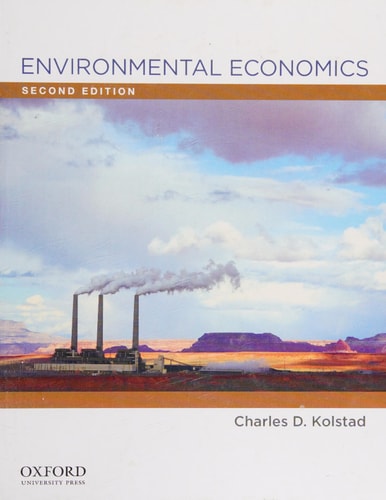
Environmental Economics
0
0
As an Amazon Associate and affiliate partner, Menrva Books earns from qualifying purchases. Learn more
Author Description
Environmental Economics is the first text to concentrate solely on environmental economics--the problems of earth, air, and water pollution from an economic perspective--with an emphasis on both government regulation and private-sector anti-pollution incentives.With the assumption that readers already have an understanding of intermediate microeconomics, the book reaches into more detail on theory and analysis than most other textbooks in this area. Now fully revised in its second edition, Environmental Economics is divided into four primary sections: the first section defines the field of environmental economics in relation to general economics and to ecological and resource economics; the second section is normative, looking at market failure and asks why, even with apparent environmental protection, the market often fails to work properly; the third section is positive, examining government regulation of pollution using the industrial organization literature; and the final section covers more advanced topics, looking at risk, uncertainty, green accounting, international competition and cooperation and development.Including many international examples, the book places special emphasis on the ways that countries around the world approach and control their own environmental problems. Environmental Economics, Second Edition, is ideal for undergraduate economics courses and beginning graduate courses in environmental management.New to this Edition* Utilizes a new structure: the first part is normative, the second part positive* Provides an updated treatment of valuation and moves it to the first part of the text* Substantially revises coverage of cost-benefit analysis, property rights, and market failure, resulting in greater clarity* Includes new chapters on voluntary environmental protection and additional sections on discounting and dynamics* Offers increased coverage of open access resources and fisheries* The technical level throughout the text is much more consi
Menrva's Summary
THE THESIS
This text investigates the economic mechanisms governing environmental pollution and the efficacy of various regulatory frameworks. Author Charles D. Kolstad, a recognized expert in the field, utilizes intermediate microeconomic theory to analyze how market failures contribute to environmental degradation. The book provides a rigorous analytical framework for evaluating both government-led regulatory interventions and private-sector incentives designed to mitigate pollution.
THE SCOPE MAP
What You Will Find
- Theoretical analysis of market failure and environmental externalities.
- Comparative study of government regulation versus private-sector anti-pollution incentives.
- Examination of advanced topics including risk, uncertainty, green accounting, and international cooperation.
- Case studies and examples illustrating diverse global approaches to environmental management.
THE AUTHORITY PERSPECTIVE
Experts and educators frequently identify this work as a foundational text for undergraduate and beginning graduate students in economics and environmental management. Readers often note the technical density of the prose, which assumes a prior understanding of intermediate microeconomics to fully grasp the analytical models presented.
Page Count:
496
Publication Date:
2010-03-31
Publisher:
Oxford University Press
ISBN-10:
0199732647
ISBN-13:
9780199732647
Economics
Public Policy
textbook
Community Tags
Other Editions(2)
Similar Books





Reader Comments
Share Your Thoughts
No comments yet. Be the first to share your thoughts!