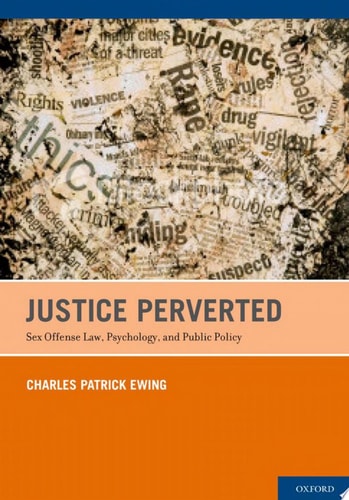
Justice Perverted: Sex Offense Law, Psychology, and Public Policy
0
0
As an Amazon Associate and affiliate partner, Menrva Books earns from qualifying purchases. Learn more
Author Description
Over the past quarter century Congress, state legislatures and the courts have radically reshaped America's laws dealing with sex offenders in an effort to reduce the prevalence of sex offenses. Most convicted sex offenders must now register with the authorities, who then make information about them available to the public. Possession of child pornography has been made an extremely serious crime often punishable by prison sentences that dwarf those meted out to child molesters, rapists, robbers, and even killers. Federal law now imposes a minimum sentence of ten years in prison for those convicted of using the internet to attempt to lure minors for sex. And the federal government and 20 states have "sexually violent predator" laws that allow the indefinite civil commitment of convicted sex offenders to secure institutions for treatment after they have served their full criminal sentences.All of these changes in sex offender law, as well as numerous others, have been based at least in part on input from psychology, psychiatry and the social sciences. Moreover, enforcement and administration of many of these laws relies to a large extent on the efforts of mental health professionals. However, many questions about this involvement remain largely unanswered. Are these laws supported by empirical evidence, or even by well-reasoned psychological theories? Do these laws actually work? Are mental health professionals capable of reliably determining an offender's future behavior, and how best to manage it? Finally, are experts capable of providing effective treatment for sex offenders -- i.e., treatment that actually reduces the likelihood that an identified sex offender will re-offend?In Justice Perverted, Charles Patrick Ewing poses these difficult questions and others that few in either law or psychology have asked, much less tried to answer. Drawing on research from across the social and behavioral sciences, he weighs the evidence for the spectrum of sex offense laws, to
Menrva's Summary
THE THESIS
Does the current framework of American sex offense law align with empirical psychological evidence and effective public policy outcomes? Charles P. Ewing, a professor of law and psychology, examines the intersection of legislative mandates and behavioral science. He critiques the reliance on mental health professionals to predict recidivism and manage offender populations, questioning whether these policies are grounded in rigorous data or merely reactive political pressure.
THE SCOPE MAP
What You Will Find
- Analysis of sex offender registration and public notification statutes.
- Evaluation of civil commitment laws for sexually violent predators.
- Review of sentencing guidelines for child pornography and internet-based offenses.
- Assessment of the efficacy of psychological treatment programs in reducing recidivism.
THE AUTHORITY PERSPECTIVE
Experts in the field of forensic psychology and criminal justice recognize this work as a critical interrogation of the intersection between mental health expertise and punitive legislation. Readers frequently note the author's ability to synthesize complex legal history with behavioral science to challenge the efficacy of current public safety policies.
Page Count:
256
Publication Date:
2011-03-16
Publisher:
Oxford University Press
ISBN-10:
0199732671
ISBN-13:
9780199732678
Psychology
Law
Sex Offenders
Criminology
Sociology
Public Policy
Community Tags
Similar Books