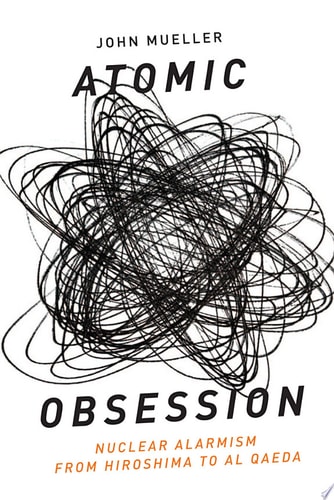
Atomic Obsession: Nuclear Alarmism from Hiroshima to Al-Qaeda
0
0
As an Amazon Associate and affiliate partner, Menrva Books earns from qualifying purchases. Learn more
Author Description
Following 9/11, Americans were swept up in a near hysteria-level fear of terrorists, especially of Islamic extremists working domestically. The government and media reports stoked fears that people living in the US have the desire and means to wreak extreme havoc and destruction. Early reports estimated slightly more than 300 al Qaeda operatives living in the United States. It wasn't long before this number became 2,000 or 5,000 domestic terrorists. As these estimates snowballed, so did spending on federal counterterrorism organizations and measures, spending which now totals over a trillion dollars. The federal government launched more covert operations in the name of fighting terrorist adversaries than they did in the entirety of the forty-five year Cold War. For each apprehension of a credible terrorist suspect, the US government created or re-organized two counterterrorism organizations. The scale of these efforts has been enormous, yet somehow they have not been proven to make Americans feels safe from what they perceive to be a massive terrorist threat. But how well-founded is this fear? Is the threat of terrorism in the United States as vast as it seems and are counterterrorism efforts effective and appropriately-scaled? It has not, statistically speaking, been efficient or successful. Only one alarm in 10,000 has proven to be a legitimate threat-the rest are what the authors refer to as "ghosts." These ghosts are enormous drains on resources and contribute to a countrywide paranoia that has resulted in widespread support and minimal critical questioning of massive expenditures and infringements on civil liberties, including invasions of privacy and questionably legal imprisonments. In Chasing Ghosts, John Mueller and Mark Stewart argue that the "ghost chase" occupying American fears, law enforcement, and federal spending persists because the public believes that there exists in the US a dire and significant threat of terrorism. The authors seek to analyze to
Menrva's Summary
THE THESIS
Does the perceived threat of nuclear terrorism in the United States align with empirical evidence, or is it a product of institutional alarmism? John Mueller, a political scientist specializing in international relations, examines the discrepancy between the actual statistical probability of nuclear attacks and the massive federal expenditures dedicated to counterterrorism. By analyzing post-9/11 policy shifts, media narratives, and government spending, the author argues that the current security apparatus is disproportionately scaled to address threats that are largely hypothetical.
THE SCOPE MAP
What You Will Find
- Historical analysis of nuclear proliferation fears from the Cold War to the present.
- Statistical evaluation of terrorist capabilities versus government threat assessments.
- Examination of federal spending patterns and the growth of counterterrorism bureaucracy.
- Critique of the socio-political impact of fear-based policy on civil liberties.
THE AUTHORITY PERSPECTIVE
Experts in political science and security studies frequently cite this work for its rigorous challenge to conventional wisdom regarding national security spending. Readers often note the analytical density of the prose, which relies heavily on statistical data to dismantle popular narratives about the efficacy of current counterterrorism measures.
Page Count:
336
Publication Date:
2009-01-01
Publisher:
Oxford University Press
ISBN-10:
0199745811
ISBN-13:
9780199745814
History
Terrorism
Nuclear weapons
National security
Public Policy
International Security
Trades & Technology
Technology & Engineering
Military History
Social Aspects
Community Tags
Similar Books