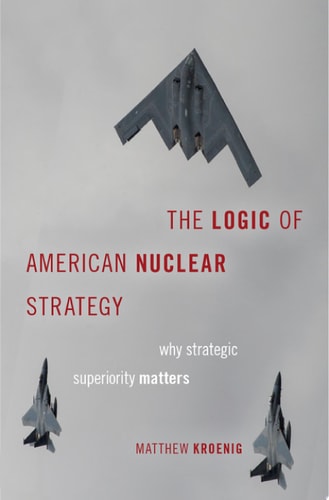
The Logic of American Nuclear Strategy: Why Strategic Superiority Matters
0
0
As an Amazon Associate and affiliate partner, Menrva Books earns from qualifying purchases. Learn more
Author Description
For decades, the reigning scholarly wisdom about nuclear weapons policy has been that the United States only needs the ability to absorb an enemy nuclear attack and still be able to respond with a devastating counterattack. So long as the US, or any other nation, retains such an assured retaliation capability, no sane leader would intentionally launch a nuclear attack against it, and nuclear deterrence will hold. According to this theory, possessing more weapons than necessary for a second-strike capability is illogical.This argument is reasonable, but, when compared to the empirical record, it raises an important puzzle. Empirically, we see that the United States has always maintained a nuclear posture that is much more robust than a mere second-strike capability. In The Logic of American Nuclear Strategy, Matthew Kroenig challenges the conventional wisdom and explains why a robust nuclear posture, above and beyond a mere second-strike capability, contributes to a state's national security goals. In fact, when a state has a robust nuclear weapons force, such a capability reduces its expected costs in a war, provides it with bargaining leverage, and ultimately enhances nuclear deterrence. This book provides a novel theoretical explanation for why military nuclear advantages translate into geopolitical advantages. In so doing, it helps resolve one of the most-intractable puzzles in international security studies.Buoyed by an innovative thesis and a vast array of historical and quantitative evidence, The Logic of American Nuclear Strategy will force scholars to reconsider their basic assumptions about the logic of nuclear deterrence.
Menrva's Summary
THE THESIS
This book investigates why the United States has consistently maintained a nuclear posture that exceeds the requirements of a simple second-strike capability. Matthew Kroenig, a scholar in international security, challenges the prevailing academic consensus that nuclear superiority is unnecessary for deterrence. He argues that a robust nuclear force provides tangible geopolitical advantages, including increased bargaining leverage and reduced costs during wartime. The author utilizes a combination of theoretical modeling and empirical analysis to demonstrate how military nuclear advantages translate into broader strategic success.
THE SCOPE MAP
What You Will Find
- Theoretical framework linking nuclear force size to geopolitical bargaining power
- Quantitative analysis of nuclear posture and international conflict outcomes
- Historical case studies of nuclear brinkmanship and crisis management
Scope Limits
- The text does not provide a technical manual for nuclear weapon design or maintenance
- It does not focus on the domestic political processes of nuclear procurement
THE AUTHORITY PERSPECTIVE
Experts in international security view this work as a significant challenge to the long-standing doctrine of minimum deterrence. Readers frequently note the academic density of the prose, which is intended for students and practitioners of strategic studies.
Page Count:
274
Publication Date:
2018-01-01
Publisher:
Oxford University Press
ISBN-10:
0190849207
ISBN-13:
9780190849207
Nuclear Strategy
International Security
International relations
International business
Military History
National security