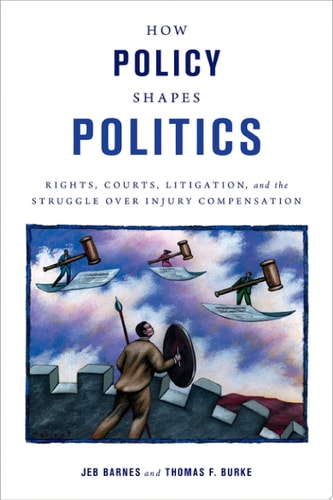
How Policy Shapes Politics: Rights, Courts, Litigation, and the Struggle Over Injury Compensation
0
0
As an Amazon Associate and affiliate partner, Menrva Books earns from qualifying purchases. Learn more
Author Description
Judicialization, juridification, legalization-whatever terms they use, scholars, commentators and citizens are fascinated by what one book has called "The Global Rise of Judicial Power" and seek to understand its implications for politics and society. In How Policy Shapes Politics, Jeb Barnes and Thomas F. Burke find that the turn to courts, litigation, and legal rights can have powerful political consequences.Barnes and Burke analyze the field of injury compensation in the United States, in which judicialized policies operate side-by-side with bureaucratized social insurance programs. They conclude that litigation, by dividing social interests into victims and villains, winners and losers, generates a fractious, chaotic politics in which even seeming allies-business and professional groups on one side, injured victims on the other-can become divided amongst themselves. By contrast, social insurance programs that compensate for injury bring social interests together, narrowing the scope of conflict and over time producing a more technocratic politics.Policy does, in fact, create politics. But only by comparing the political trajectories of different types of policies -- some more court-centered, others less so -- can we understand the consequences of arguably one of the most significant developments in post-World War II government, the increasingly prominent role of courts, litigation, and legal rights in politics.
Menrva's Summary
THE THESIS
How do different policy structures, specifically those centered on litigation versus social insurance, fundamentally alter the landscape of American political conflict? Jeb E. Barnes and Thomas F. Burke utilize their expertise in political science to examine the post-World War II American injury compensation system. By contrasting court-centered legal frameworks with bureaucratized social insurance models, the authors argue that the design of a policy dictates the nature of political mobilization and the resulting social dynamics.
THE SCOPE MAP
What You Will Find
- Comparative analysis of litigation-based injury compensation versus social insurance programs.
- Examination of how legal rights and judicial processes influence interest group behavior.
- Case studies focusing on the political consequences of policy design in the United States.
- Theoretical framework regarding the 'policy creates politics' paradigm.
THE AUTHORITY PERSPECTIVE
Scholars in political science and legal studies frequently cite this work as a significant contribution to the literature on the judicialization of politics. Experts highlight the authors' ability to bridge the gap between institutional design and political outcomes, making it a foundational text for understanding the mechanics of American policy development.
Page Count:
272
Publication Date:
2015-01-02
Publisher:
Oxford University Press
ISBN-10:
0199756112
ISBN-13:
9780199756117
Professional Career & Trade
Law
Damages
American History
Vaccines
Public Administration
Sociology
Torts
Compensation Law
Public Policy
Community Tags
Similar Books