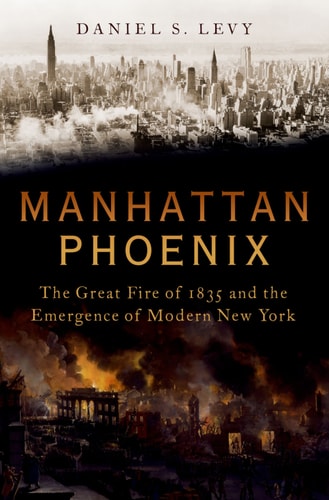
Manhattan Phoenix: The Great Fire of 1835 and the Emergence of Modern New York
0
0
As an Amazon Associate and affiliate partner, Menrva Books earns from qualifying purchases. Learn more
Author Description
Shows vividly how the Great Fire of 1835, which nearly leveled Manhattan also created the ashes from which the city was reborn.On a freezing December night almost two centuries ago, a fire erupted in lower Manhattan. The city's inhabitants, though accustomed to blazes in a town with so many wooden structures, a spotty water supply, and a decentralized fire department, looked on in horror at the scale of this one. Philip Hone, a former mayor of New York, wrote in his diary how "the progress of the flames, like flashes of lightning, communicated in every direction, and a few minutes sufficed to level the lofty edifices on every side." By the time the fire was extinguished, a huge swath of land had been transformed from a thriving business center into the "Burnt District," an area roughly the same size as was devastated during the September 11th attack. In the end, nearly 700 buildings were destroyed. So vast was the conflagration that it was immediately and henceforth known as the Great Fire of 1835. Manhattan Phoenix reveals how New York emerged from the disaster to become a global powerhouse merely a quarter of a century later. Daniel S. Levy's book charts the city's almost miraculous growth during the early 19th century by focusing on the topics that shaped its destiny, starting with fire but including water, land, disease, culture, and politics, interweaving the lives of New Yorkers who took part in its transformation. Some are well-known, including the land baron John Jacob Astor. Others less so, as with the Bowery Theatre impresario Thomas Hamblin and the African-American restaurateur Thomas Downing. The book celebrates Fire Chief James Gulick, who battled the Great Fire, examines the designs of the architect Alexander Jackson Davis who built marble palaces for the rich, follows the abolitionist Arthur Tappan, chronicles the career of the merchant Alexander Stewart, and reveals how the engineer John Bloomfield Jervis succeeded in bringing clean water into homes.
Menrva's Summary
THE THESIS
This book investigates how the catastrophic Great Fire of 1835 served as the catalyst for the rapid urban, political, and infrastructural modernization of New York City. Daniel S. Levy, a seasoned journalist and historian, utilizes primary source accounts—including the diaries of former mayor Philip Hone—to reconstruct the event and its aftermath. The text argues that the destruction of the city's commercial center forced a radical reimagining of urban planning, water management, and social organization. By tracing the lives of diverse figures from land barons to theater impresarios, the author demonstrates how the city leveraged this disaster to transition into a global economic powerhouse.
THE SCOPE MAP
What You Will Find
- A detailed chronological account of the 1835 conflagration and the destruction of the 'Burnt District.'
- Analysis of 19th-century urban infrastructure challenges, specifically water supply and fire prevention.
- Biographical sketches of influential figures including John Jacob Astor, James Gulick, and Thomas Downing.
- Examination of the intersection between disaster recovery, political policy, and social reform in early New York.
THE AUTHORITY PERSPECTIVE
Historians and urban studies scholars recognize this work as a comprehensive examination of a pivotal, yet often overlooked, moment in American municipal history. Readers frequently note the accessible narrative style that effectively balances technical details of urban development with the personal experiences of historical figures.
Page Count:
469
Publication Date:
2021-01-01
Publisher:
Oxford University Press
ISBN-10:
019975246X
ISBN-13:
9780199752461
History
Special Topics
Social History
American History
Urban History
History of the Americas
America history
Community Tags
Similar Books