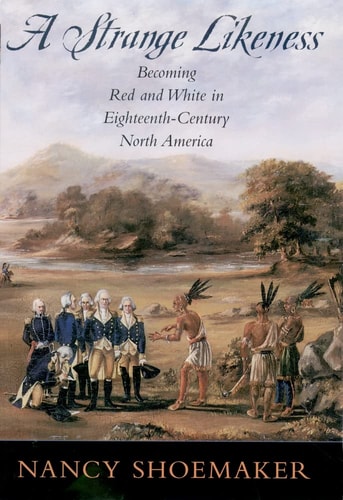
A Strange Likeness: Becoming Red and White in Eighteenth-Century North America
0
0
As an Amazon Associate and affiliate partner, Menrva Books earns from qualifying purchases. Learn more
Author Description
The relationship between American Indians and Europeans on America's frontiers is typically characterized as a series of cultural conflicts and misunderstandings based on a vast gulf of difference. Nancy Shoemaker turns this notion on its head, showing that Indians and Europeans shared common beliefs about their most fundamental realities--land as national territory, government, record-keeping, international alliances, gender, and the human body.Before they even met, Europeans and Indians shared perceptions of a landscape marked by mountains and rivers, a physical world in which the sun rose and set every day, and a human body with its own distinctive shape. They also shared in their ability to make sense of it all and to invent new, abstract ideas based on the tangible and visible experiences of daily life. Focusing on eastern North America up through the end of the Seven Years War, Shoemaker closely reads incidents, letters, and recorded speeches from the Iroquois and Creek confederacies, the Cherokee Nation, and other Native groups alongside British and French sources, paying particular attention to the language used in cross-cultural conversation.Paradoxically, the more American Indians and Europeans came to know each other, the more they came to see each other as different. By the end of the 18th century, Shoemaker argues, they abandoned an initial willingness to recognize in each other a common humanity and instead developed new ideas rooted in the conviction that, by custom and perhaps even by nature, Native Americans and Europeans were peoples fundamentally at odds. In her analysis, Shoemaker reveals the 18th century roots of enduring stereotypes Indians developed about Europeans, as well as stereotypes Europeans created about Indians. This powerful and eloquent interpretation questions long-standing assumptions, revealing the strange likenesses among the inhabitants of colonial North America.
Menrva's Summary
THE THESIS
This book investigates the paradox of how eighteenth-century North American interactions between Indigenous peoples and Europeans evolved from an initial recognition of shared humanity into a rigid framework of fundamental difference. Nancy Shoemaker, a historian specializing in Native American history, utilizes a comparative analysis of primary source documents—including speeches, letters, and colonial records—to challenge the traditional historiography of inevitable cultural incompatibility. She argues that both groups initially perceived commonalities in their physical and social realities, only to construct mutually exclusive stereotypes as their political and territorial conflicts intensified.
THE SCOPE MAP
What You Will Find
- Analysis of cross-cultural communication between the Iroquois, Creek, Cherokee, and European colonial powers.
- Examination of shared conceptual frameworks regarding land, governance, and the human body.
- Comparative study of primary source documents from the seventeenth century through the end of the Seven Years War.
- Investigation into the historical origins of enduring racial and cultural stereotypes in North America.
THE AUTHORITY PERSPECTIVE
Scholars frequently cite this work for its nuanced approach to colonial-era cross-cultural relations and its focus on the linguistic construction of identity. The text is recognized as a significant contribution to the field of ethnohistory, providing a dense but accessible analysis of how perceptions of 'otherness' were manufactured over time.
Page Count:
224
Publication Date:
2004-03-25
Publisher:
Oxford University Press
ISBN-10:
0195167929
ISBN-13:
9780195167924
History
Whites
America history
North America
Colonial History
America
American History
Sociology
Anthropology
Pioneer Life
United States
Community Tags
Similar Books