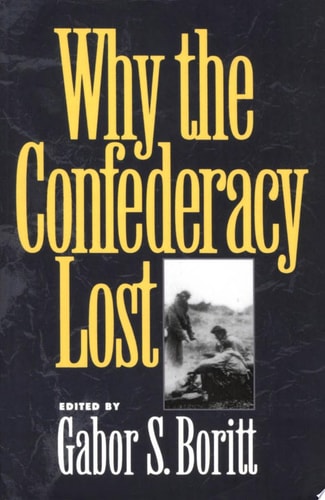
Why the Confederacy Lost (Gettysburg Civil War Institute Books)
0
0
As an Amazon Associate and affiliate partner, Menrva Books earns from qualifying purchases. Learn more
Author Description
After the Civil War, someone asked General Pickett why the Battle of Gettysburg had been lost: Was it Lee's error in taking the offensive, the tardiness of Ewell and Early, or Longstreet's hesitation in attacking? Pickett scratched his head and replied, "I've always thought the Yankees had something to do with it." This simple fact, writes James McPherson, has escaped a generation of historians who have looked to faulty morale, population, economics, and dissent as the causes of Confederate failure. These were all factors, he writes, but the Civil War was still a war--won by the Union army through key victories at key moments.With this brilliant review of how historians have explained the Southern defeat, McPherson opens a fascinating account by several leading historians of how the Union broke the Confederate rebellion. In every chapter, the military struggle takes center stage, as the authors reveal how battlefield decisions shaped the very forces that many scholars (putting the cart before the horse) claim determined the outcome of the war. Archer Jones examines the strategy of the two sides, showing how each had to match its military planning to political necessity. Lee raided north of the Potomac with one eye on European recognition and the other on Northern public opinion--but his inevitable retreats looked like failure to the Southern public. The North, however, developed a strategy of deep raids that was extremely effective because it served a valuable political as well as military purpose, shattering Southern morale by tearing up the interior. Gary Gallagher takes a hard look at the role of generals, narrowing his focus to the crucial triumvirate of Lee, Grant, and Sherman, who towered above the others. Lee's aggressiveness may have been costly, but he well knew the political impact of his spectacular victories; Grant and Sherman, meanwhile, were the first Union generals to fully harness Northern resources and carry out coordinated campaigns. Reid Mitchell
Menrva's Summary
THE THESIS
This collection of essays investigates the primary question of why the Confederacy lost the American Civil War by re-centering the military struggle as the decisive factor in the conflict's outcome. Edited by Gabor S. Boritt, the volume features contributions from prominent historians such as James McPherson, Archer Jones, and Gary Gallagher. The authors argue that while socio-economic and morale-based theories are relevant, they often obscure the reality that the Union victory was fundamentally secured through superior military strategy and battlefield execution.
THE SCOPE MAP
What You Will Find
- Analysis of Union and Confederate military strategies and their alignment with political objectives.
- Examination of the leadership styles and campaign coordination of key generals including Lee, Grant, and Sherman.
- Evaluation of how battlefield decisions influenced public opinion and international recognition.
- Synthesis of historiographical debates regarding the relative importance of military versus non-military factors in the Southern defeat.
THE AUTHORITY PERSPECTIVE
Historians and students of the Civil War frequently cite this work as a critical corrective to deterministic theories that overlook the agency of military commanders. The text is noted for its accessible yet rigorous analysis, making it a standard reference for those studying the intersection of political necessity and military operations.
Page Count:
221
Publication Date:
1993-01-01
Publisher:
Oxford University Press
ISBN-10:
0199879729
ISBN-13:
9780199879724
History
Civil War
America history
American History
Military History
Community Tags
Similar Books