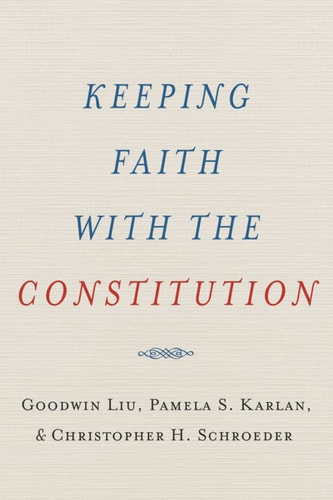
Keeping Faith with the Constitution (Inalienable Rights)
0
0
As an Amazon Associate and affiliate partner, Menrva Books earns from qualifying purchases. Learn more
Author Description
Chief Justice John Marshall argued that a constitution "requires that only its great outlines should be marked [and] its important objects designated." Ours is "intended to endure for ages to come, and consequently, to be adapted to the various crises of human affairs." In recent years, Marshall's great truths have been challenged by proponents of originalism and strict construction. Such legal thinkers as Supreme Court Justice Antonin Scalia argue that the Constitution must be construed and applied as it was when the Framers wrote it.In Keeping Faith with the Constitution, three legal authorities make the case for Marshall's vision. They describe their approach as "constitutional fidelity"--not to how the Framers would have applied the Constitution, but to the text and principles of the Constitution itself. The original understanding of the text is one source of interpretation, but not the only one; to preserve the meaning and authority of the document, to keep it vital, applications of the Constitution must be shaped by precedent, historical experience, practical consequence, and societal change. The authors range across the history of constitutional interpretation to show how this approach has been the source of our greatest advances, from Brown v. Board of Education to the New Deal, from the Miranda decision to the expansion of women's rights. They delve into the complexities of voting rights, the malapportionment of legislative districts, speech freedoms, civil liberties and the War on Terror, and the evolution of checks and balances. The Constitution's framers could never have imagined DNA, global warming, or even women's equality. Yet these and many more realities shape our lives and outlook. Our Constitution will remain vital into our changing future, the authors write, if judges remain true to this rich tradition of adaptation and fidelity.
Menrva's Summary
THE THESIS
This book investigates whether the United States Constitution should be interpreted through the rigid lens of originalism or through a framework of constitutional fidelity that allows for adaptation to modern societal needs. The authors, all distinguished legal scholars and practitioners, argue that the document's longevity depends on its ability to evolve alongside human affairs. They present a methodology that balances the original text and principles with historical experience, judicial precedent, and practical consequences to ensure the Constitution remains a functional governing instrument.
THE SCOPE MAP
What You Will Find
- An analysis of the constitutional fidelity framework versus originalism and strict construction.
- Historical case studies including Brown v. Board of Education, the New Deal, and the Miranda decision.
- Discussions on contemporary legal challenges such as voting rights, civil liberties, and the War on Terror.
- An examination of how the Constitution addresses modern realities like technological advancement and evolving social norms.
THE AUTHORITY PERSPECTIVE
Legal scholars and practitioners frequently cite this work as a primary defense of living constitutionalism against the rise of originalist jurisprudence. Experts highlight the text as a clear, accessible articulation of how judicial interpretation has historically functioned to maintain the relevance of the American legal system.
Page Count:
272
Publication Date:
2010-01-01
Publisher:
Oxford University Press
ISBN-10:
0199752834
ISBN-13:
9780199752836
History
United States
Constitutional Law
Law
Professional Career & Trade
Constitutions
Government
Community Tags
Similar Books