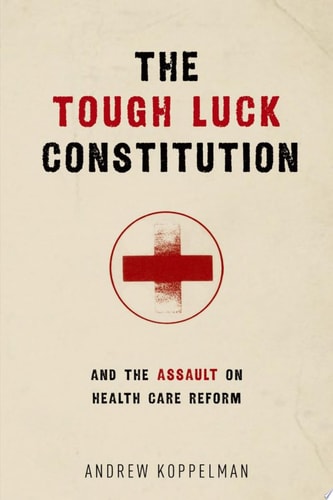
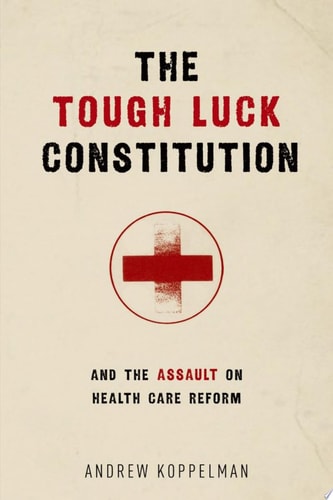
The Tough Luck Constitution and the Assault on Health Care Reform
0
0
As an Amazon Associate and affiliate partner, Menrva Books earns from qualifying purchases. Learn more
Author Description
Chief Justice John Roberts stunned the nation by upholding the Affordable Care Act--more commonly known as Obamacare. But legal experts observed that the decision might prove a strategic defeat for progressives. Roberts grounded his decision on Congress's power to tax. He dismissed the claim that it is allowed under the Constitution's commerce clause, which has been the basis of virtually all federal regulation--now thrown in doubt.In The Tough Luck Constitution and the Assault on Health Care Reform, Andrew Koppelman explains how the Court's conservatives embraced the arguments of a fringe libertarian legal movement bent on eviscerating the modern social welfare state. They instead advocate what Koppelman calls a "tough luck" philosophy: if you fall on hard times, too bad for you. He argues that the rule they proposed--that the government can't make citizens buy things--has nothing to do with the Constitution, and that it is in fact useless to stop real abuses of power, as it was tailor-made to block this one law after its opponents had lost in the legislature. He goes on to dismantle the high court's construction of the commerce clause, arguing that it almost crippled America's ability to reverse rising health-care costs and shrinking access. Koppelman also places the Affordable Care Act within a broader historical context. The Constitution was written to increase central power, he notes, after the failure of the Articles of Confederation. The Supreme Court's previous limitations on Congressional power have proved unfortunate: it has struck down anti-lynching laws, civil-rights protections, and declared that child-labor laws would end "all freedom of commerce, and... our system of government [would] be practically destroyed." Both somehow survived after the court revisited these precedents. Koppelman notes that the arguments used against Obamacare are radically new--not based on established constitutional principles. Ranging from early constitutional history to pot
Menrva's Summary
THE THESIS
Does the Supreme Court's interpretation of the Constitution regarding the Affordable Care Act represent a legitimate legal evolution or a politically motivated assault on the social welfare state? Andrew Koppelman, a professor of law and political science, examines the legal arguments used by conservative justices to challenge the Affordable Care Act. He argues that these arguments stem from a fringe libertarian ideology rather than established constitutional precedent, ultimately threatening the federal government's capacity to regulate commerce and provide social protections.
THE SCOPE MAP
What You Will Find
- An analysis of the Supreme Court's commerce clause jurisprudence and its historical impact on federal regulation.
- A critique of the "tough luck" libertarian legal philosophy and its influence on modern judicial decision-making.
- A historical review of constitutional challenges to federal laws, including anti-lynching and child-labor legislation.
- An examination of the legislative and judicial conflict surrounding the Affordable Care Act.
THE AUTHORITY PERSPECTIVE
Legal scholars and political analysts frequently cite this work as a critical examination of the intersection between judicial activism and health care policy. Readers note the text provides a rigorous, albeit partisan, critique of the conservative legal movement's influence on the Supreme Court.
Page Count:
207
Publication Date:
2013-01-01
Publisher:
Oxford University Press
ISBN-10:
0199970041
ISBN-13:
9780199970049
History
Politics
Medical Law
Health Care
Insurance Law
Public Policy
Constitutions
Constitutional Law
Law
Health insurance
Professional Career & Trade
United States
Community Tags
Other Editions(2)
Similar Books







Reader Comments
Share Your Thoughts
No comments yet. Be the first to share your thoughts!