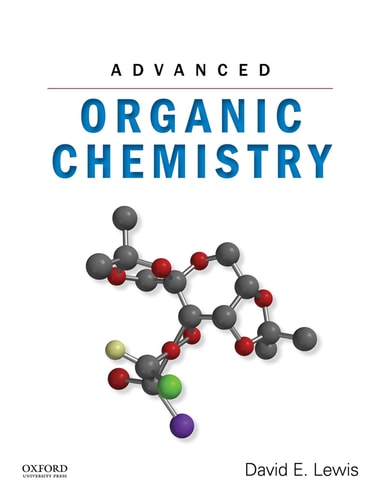
Advanced Organic Chemistry
0
0
As an Amazon Associate and affiliate partner, Menrva Books earns from qualifying purchases. Learn more
Author Description
Written by a master teacher, Advanced Organic Chemistry presents a clear, concise, and complete overview of the subject that is ideal for both advanced undergraduate and graduate courses. In contrast with many other books, this volume is a true textbook, not a reference book.FEATURES* Uses a unique method of categorizing organic reactions that is based on reactivity principles rather than mechanism or functional group, enabling students to see reactivity patterns in superficially widely disparate systems* Emphasizes fundamental physical organic concepts that reinforce themes, giving students the foundation to understand both mechanisms and synthesis* Covers asymmetric methodologies, a topic that is now ubiquitous in the current literature* Numerous in-chapter worked problems and end-of-chapter additional exercises allow students to apply concepts as they learn them* More than 2500 references to the primary literature in the body of the book(along with another 750 references in the problems) encourage students to become familiar with real scholarship as they master the concepts* Brief historical vignettes about relevant chemists reinforce a historical and humanizing approach to learning science
Menrva's Summary
THE THESIS
This text investigates the core principles of organic chemistry by shifting the focus from rote memorization of functional groups to the underlying reactivity patterns that govern chemical transformations. Author David E. Lewis, a seasoned educator, constructs a pedagogical framework designed for advanced undergraduate and graduate students. By prioritizing physical organic concepts, the book provides a rigorous foundation that allows learners to predict mechanisms and synthesize complex molecules with greater logical consistency.
THE SCOPE MAP
What You Will Find
- A reactivity-based classification system for organic reactions that transcends traditional functional group categorization.
- Comprehensive coverage of asymmetric methodologies and their applications in modern chemical synthesis.
- Over 3,250 total references to primary scientific literature integrated throughout the text and problem sets.
- Historical vignettes that contextualize scientific developments within the lives of the chemists who pioneered them.
THE AUTHORITY PERSPECTIVE
Experts and educators frequently highlight this text for its departure from the encyclopedic style of traditional reference books in favor of a cohesive, instructional narrative. Students and instructors often note that the reactivity-based approach provides a more intuitive understanding of complex chemical systems compared to standard curriculum materials.
Page Count:
1176
Publication Date:
2015-09-15
Publisher:
Oxford University Press
ISBN-10:
0199758972
ISBN-13:
9780199758975
Science
textbook
Academic
Chemistry
Organic chemistry
Community Tags
Other Editions(2)
Similar Books