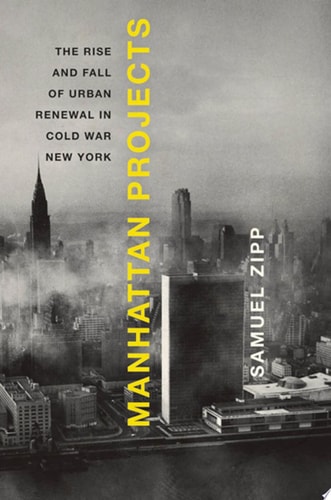
Manhattan Projects: The Rise and Fall of Urban Renewal in Cold War New York
0
0
As an Amazon Associate and affiliate partner, Menrva Books earns from qualifying purchases. Learn more
Author Description
Moving beyond the usual good-versus-evil story that pits master-planner Robert Moses against the plucky neighborhood advocate Jane Jacobs, Samuel Zipp sheds new light on the rise and fall of New York's urban renewal in the decades after World War II. In a book praised by Times Literary Supplement as "richly detailed and thoughtfully written" and by Wall Street Journal as "compelling," Samuel Zipp sheds new light on the rise and fall of urban renewal in the decades after World War II. Focusing on four iconic "Manhattan projects"--The United Nations building, Stuyvesant Town, Lincoln Center, and the great swaths of public housing in East Harlem--Zipp unearths a host of forgotten stories and characters that flesh out the conventional history of urban renewal. He shows how boosters hoped to make Manhattan the capital of modernity and a symbol of American power, but even as the builders executed their plans, a chorus of critics revealed the dark side of those visions, attacking urban renewal for perpetuating deindustrialization, racial segregation, and class division, for uprooting thousands, and for implanting a new, alienating cityscape. Urban renewal was not merely a failed planning ideal, Zipp concludes, but also a crucial phase in the transformation of New York into a world city, but one mired in urban crisis. The book won Honorable Mention for the Ellis W. Hawley Prize of the Organization of American Historians. -- Publisher description.
Menrva's Summary
THE THESIS
How did the ambitious urban renewal projects of post-World War II New York City simultaneously serve as symbols of American power and catalysts for social and economic crisis? Samuel Zipp, an expert in American studies and urban history, examines the intersection of modernist planning and the lived reality of New Yorkers during the Cold War era. By analyzing the tension between the vision of Manhattan as a global capital and the resulting displacement and segregation, Zipp argues that urban renewal was a complex, transformative process that fundamentally reshaped the city's social fabric.
THE SCOPE MAP
What You Will Find
- Detailed case studies of the United Nations building, Stuyvesant Town, Lincoln Center, and East Harlem public housing.
- An analysis of the ideological shift toward making Manhattan a symbol of modernity and global influence.
- Examination of the negative impacts of renewal, including deindustrialization, racial segregation, and class division.
- A historical framework connecting mid-century planning policies to the subsequent urban crises of the late 20th century.
THE AUTHORITY PERSPECTIVE
Critics and historians recognize this work as a nuanced departure from the binary narrative of Robert Moses versus Jane Jacobs. Scholars frequently highlight the book's ability to synthesize complex architectural history with the broader social consequences of urban development.
Page Count:
469
Publication Date:
2010-01-01
Publisher:
Oxford University Press
ISBN-10:
019975070X
ISBN-13:
9780199750702
Architecture
History
Politics
Americas
Categories
Sociology
urban planning
Public Policy
New York
Cold War
Kindle Store
Kindle eBooks
Urban
Urban renewal
Community Tags
Similar Books