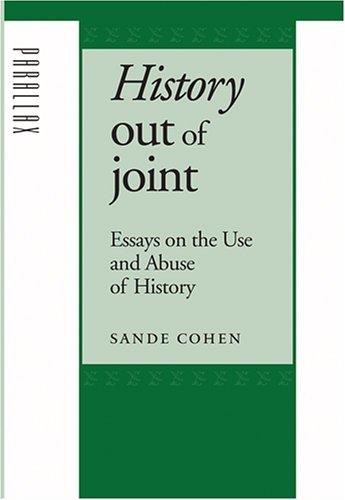
History Out of Joint
0
0
As an Amazon Associate and affiliate partner, Menrva Books earns from qualifying purchases. Learn more
Author Description
In History Out of Joint, Sande Cohen considers the ways in which historical narratives summon up a past and lay down a future in the ever-multiplying intellectual debates of contemporary public culture. As competing factions advance contradictory principles to validate or discredit their preferred accounts of the past and the present, Cohen argues that the fundamental question of how these principles themselves should be addressed - of what truly constitutes the use or abuse of history - has been pushed aside. Taking Nietzsche's idea of a simultaneous production and "anti-production" of culture as his starting point, Cohen proposes that the real abuse lies in the attempt to establish one version of history by effacing every other and shows how this now prevalent idea of historiography reduced to a political resource has itself become a "normal" starting point of such abuse. Cohen looks first at some current struggles to control public history, examining popular newspaper accounts of events in geopolitics and art, different views of the modern historian's role as a public authority, and the function of anecdote and its relationship to historical writing. He then turns to the works of several major figures in contemporary critical theory, including Derrida, Lyotard, and Deleuze and Guattari. Against the belief that their ideas led primarily to escapism, blindness, or endless deferral, Cohen demonstrates how their concepts of an affirmative yet critical event can be applied specifically to counter contemporary abuse of history and, in doing so, to resist social passivity, the nihilism and eschatological catastrophe of which they describe.--Jacket.
Menrva's Summary
THE THESIS
This book investigates the contemporary abuse of historical narratives and the principles by which they are judged. Sande Cohen examines how competing factions use contradictory principles to validate or discredit their accounts of the past and present, arguing that the fundamental question of how these principles should be addressed has been sidelined. Drawing on Nietzsche's concept of cultural production and anti-production, Cohen posits that the true abuse lies in attempts to establish a single historical version by erasing others. The book explores how history reduced to a political resource has become a common starting point for such abuse.
THE SCOPE MAP
- Analysis of public history control and popular newspaper accounts of geopolitical and art events.
- Examination of the modern historian's role as a public authority.
- Discussion on the function of anecdote and its relationship to historical writing.
- Exploration of concepts from contemporary critical theory, including Derrida, Lyotard, and Deleuze and Guattari.
- Demonstration of how critical theory concepts can counter the contemporary abuse of history.
- Argument for resisting social passivity and nihilism through a critical engagement with historical narratives.
THE AUTHORITY PERSPECTIVE
This work is positioned as a critical examination of how historical narratives are manipulated in contemporary public culture. It engages with complex theoretical frameworks from figures like Nietzsche, Derrida, and Lyotard to dissect the political use of history. The book aims to demonstrate how an affirmative yet critical approach can counter the abuse of history and resist social passivity. The author's analysis suggests a dense, theoretically-driven exploration for readers interested in historiography and critical theory.
Page Count:
307
Publication Date:
2006-01-01
ISBN-10:
0801882141
Philosophy
Non-Fiction
History
Community Tags
Similar Books














