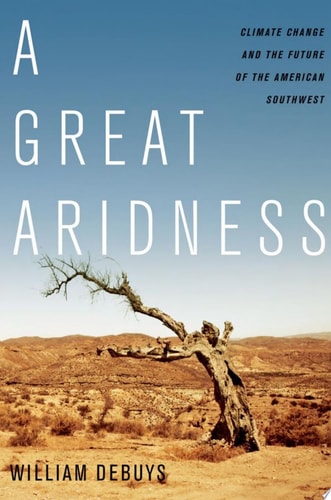
A Great Aridness
0
0
As an Amazon Associate and affiliate partner, Menrva Books earns from qualifying purchases. Learn more
Author Description
With its soaring azure sky and stark landscapes, the American Southwest is one of the most hauntingly beautiful regions on Earth. Yet staggering population growth, combined with the intensifying effects of climate change, is driving the oasis-based society close to the brink of a dust-bowl-scale catastrophe. In A Great Aridness, William deBuys paints a compelling picture of what the Southwest might look like when the heat turns up and the water runs out. This semi-arid land, vulnerable to water shortages, rising temperatures, wildfires, and a host of other environmental challenges, is poised to bear the heaviest consequences of global environmental change in the United States. Examining interrelated factors such as vanishing wildlife, forest die backs, and the over-allocation of the already stressed Colorado River--upon which nearly 30 million people depend--the author narrates the landscape's history--and future. He tells the inspiring stories of the climatologists and others who are helping untangle the complex, interlocking causes and effects of global warming. And while the fate of this region may seem at first blush to be of merely local interest, what happens in the Southwest, deBuys suggests, will provide a glimpse of what other mid-latitude arid lands worldwide--the Mediterranean Basin, Southern Africa, and the Middle East--will experience in the coming years. Written with an elegance that recalls the prose of John McPhee and Wallace Stegner, A Great Aridness offers an unflinching look at the dramatic effects of climate change occurring right now in our own backyard.
Menrva's Summary
THE THESIS
This book investigates the impending ecological and social collapse of the American Southwest as it faces the dual pressures of rapid population growth and accelerating climate change. William deBuys, an experienced environmental writer and conservationist, synthesizes climatological data, historical water policy, and on-the-ground reporting to argue that the region serves as a bellwether for global mid-latitude arid zones. He examines the systemic over-allocation of the Colorado River and the cascading effects of rising temperatures on regional biodiversity and human infrastructure. By framing the Southwest as a microcosm of global environmental instability, the author provides a framework for understanding the inevitable consequences of long-term drought and resource depletion.
THE SCOPE MAP
What You Will Find
- Analysis of the Colorado River basin and its critical role in supporting 30 million people.
- Examination of ecological indicators including forest die-backs and wildlife habitat loss.
- Profiles of climatologists and researchers working to model regional environmental shifts.
- Comparative studies linking the American Southwest to other arid regions like the Mediterranean and Southern Africa.
THE AUTHORITY PERSPECTIVE
Experts and critics frequently cite this work for its synthesis of complex environmental science and accessible, narrative-driven prose. Readers note that the text provides a sobering, evidence-based assessment of regional water policy and climate projections.
Page Count:
336
Publication Date:
2012-01-01
Publisher:
Oxford University Press
ISBN-10:
0199779104
ISBN-13:
9780199779109
Science
History
Nature
Geography
Climate Change
Environment
Community Tags
Similar Books