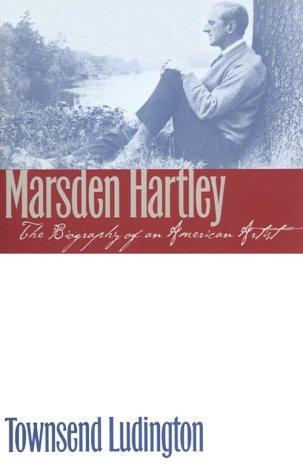
Marsden Hartley
0
0
As an Amazon Associate and affiliate partner, Menrva Books earns from qualifying purchases. Learn more
Author Description
Townsend Ludington's probing, insightful biography of Marsden Hartley is the first full-scale work on the life of one of the great American painters of our century. Two weeks after Hartley's death, in 1943, Paul Rosenberg wrote in the Nation that Hartley was an "almost gigantic secondary artist." Now, as time affords us greater perspective on that eruptive period in American art, the first half of the twentieth century, we can see that Hartley was in fact an artist of primary, not secondary, importance. His career encompassed an abundance of phases and fascinations, all of them reflecting his abiding interest in newness and his never-ending quest for his own truth and roots. As Ludington reveals here, Marsden Hartley was a man of many parts: introverted, homosexual, given to great highs and mordant lows, maligned, neglected, and sometimes praised. He was a fine technician, a restless innovator, an intellectual who could theorize brilliantly, yet whose best art often went counter to his theories. And he was an inveterate traveler: after growing up in Maine, he had an early love affair with Paris before going on to live for periods in New York, Berlin, New Mexico, Nova Scotia, Bermuda, Mexico, and finally New England once again. Along the way, he had close if sometimes volatile relationships with many influential figures in American arts and letters, among them Alfred Stieglitz, William Carlos Williams, Albert Pinkham Ryder, Gertrude Stein, and Charles Demuth.. And certainly his art itself can be seen to chart a course through a remarkable time of new discoveries and revolutionary ideas. Starting out under the spell of postimpressionism, Hartley absorbed elements of Ryder's idiosyncratic style, European modernism, the Blue Rider school, cubism, and American folk art. But when his own visions emerged--as they did in 1914 with the now famous German-officer paintings--he became noted first for the strong mysticism of his work, with its symbols and numbers, and then
Menrva's Summary
THE THESIS
Townsend Ludington's biography explores the complex life and artistic evolution of Marsden Hartley, a pivotal figure in early 20th-century American art. The book examines Hartley's multifaceted personality, marked by introversion, struggles with his homosexuality, and dramatic emotional shifts, alongside his relentless pursuit of artistic truth and identity. Ludington details Hartley's extensive travels across America and Europe, his engagement with various art movements from Post-Impressionism to Cubism and American folk art, and his significant, though sometimes tumultuous, relationships with prominent artists and writers of his era, including Alfred Stieglitz and Gertrude Stein. The narrative traces how Hartley's art, characterized by its mysticism, symbolism, and innovative techniques, reflected both his personal journey and the revolutionary artistic landscape of his time.**
THE SCOPE MAP
- Detailed exploration of Marsden Hartley's personal life, including his introversion, homosexuality, and emotional volatility.
- Analysis of Hartley's artistic development through various phases and influences, such as Post-Impressionism, Ryder's style, European modernism, the Blue Rider school, Cubism, and American folk art.
- Chronological account of Hartley's extensive travels and periods of residence in key artistic centers like Paris, New York, Berlin, New Mexico, Nova Scotia, Bermuda, Mexico, and New England.
- Examination of Hartley's significant relationships with influential figures in American arts and letters, such as Alfred Stieglitz, William Carlos Williams, Albert Pinkham Ryder, Gertrude Stein, and Charles Demuth.
- Discussion of Hartley's artistic innovations, particularly his 'German-officer paintings' and the mystical elements, symbols, and numbers present in his work.
- Contextualization of Hartley's career within the broader landscape of early 20th-century American art, highlighting his role in a period of new discoveries and revolutionary ideas.
- Insight into the tension between Hartley's theoretical ideas about art and the actual practice and vision evident in his paintings.
THE AUTHORITY PERSPECTIVE
Townsend Ludington's biography is recognized as the first comprehensive work on Marsden Hartley, a significant American painter of the 20th century. Critics have noted its probing and insightful nature, positioning Hartley as an artist of primary importance rather than secondary, as once suggested. The book is lauded for its detailed examination of Hartley's diverse artistic phases, his personal struggles and triumphs, and his extensive travels that informed his work. It effectively situates Hartley within the context of a revolutionary period in American art, highlighting his unique contributions and complex relationships with contemporaries.
Page Count:
325
Publication Date:
1992-01-01
ISBN-10:
0316535370
ISBN-13:
9780316535373
Biography
Non-Fiction
Art
Art History
American Art
Community Tags
Similar Books