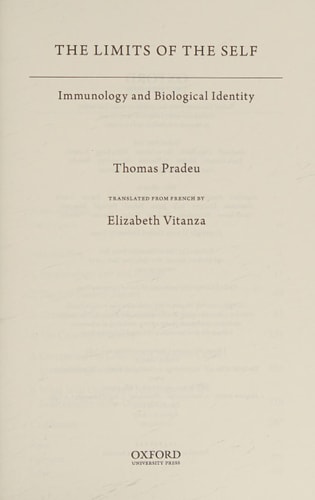
The Limits of the Self: Immunology and Biological Identity
0
0
As an Amazon Associate and affiliate partner, Menrva Books earns from qualifying purchases. Learn more
Author Description
What counts as an individual in the living world? What does it mean for a living thing to remain the same through time, while constantly changing? These questions are the province of immunology, one of the most dynamic fields in biology. Immunology answers these questions with its theory of "self" and "nonself" which has dominated the field since the 1940s. Thomas Pradeu argues that this theory is inadequate, because immune responses to self constituents and immune tolerance of foreign entities are the rule, not the exception. Instead Pradeu advances an alternative theory, the continuity theory, which offers a new way to answer the question of what triggers an immune response. It also echoes the recent realization that all organisms, and not only higher vertebrates, have an immune system.Pradeu's main thesis is that the self-nonself theory should be abandoned, but that immunology still proves to be decisive for delineating the boundaries of the organism. Articulating an evolutionary and an immunological perspective, he offers an original conception of the organism. Tolerance of the fetus by the mother and of countless bacteria on the body's surfaces proves that every organism is heterogeneous, that is, made of entities of different origins. In other words, every organism appears as a chimera, a mixed living thing-the cohesiveness of which is ensured by the constant action of its immune system.The Limits of the Self, will be essential reading for anyone interested in the definition of biological individuality and the understanding of the immune system. Key words: immune system, self, non-self, tolerance, identity, individuality, theoretical immunology, continuity-discontinuity theory, philosophy of immunology, philosophy of biology.
Menrva's Summary
THE THESIS
This book investigates the fundamental question of what constitutes a biological individual by challenging the long-standing 'self-nonself' paradigm in immunology. Thomas Pradeu, a philosopher of biology, synthesizes historical immunological data with contemporary evolutionary theory to argue that the traditional model fails to account for immune tolerance of foreign entities and responses to self-constituents. He proposes the 'continuity theory' as a more robust framework, positing that the immune system functions to maintain the cohesiveness of a heterogeneous, chimeric organism rather than merely distinguishing between self and non-self.
THE SCOPE MAP
What You Will Find
- A critical analysis of the 'self-nonself' theory that has dominated immunology since the 1940s.
- The introduction and formalization of the 'continuity theory' of immune response.
- Examination of biological phenomena such as maternal-fetal tolerance and the microbiome.
- A philosophical redefinition of the organism as a cohesive, heterogeneous chimera.
THE AUTHORITY PERSPECTIVE
Experts in the philosophy of biology and theoretical immunology recognize this work as a significant intervention in how we define biological boundaries. Readers frequently note the academic density of the prose, which requires a strong background in both biological theory and philosophical inquiry to fully grasp the implications of Pradeu's arguments.
Page Count:
320
Publication Date:
2012-02-27
Publisher:
Oxford University Press
ISBN-10:
0199775281
ISBN-13:
9780199775286
Science
Immunology
Immune System
Self Philosophy
Biology
Community Tags
Similar Books