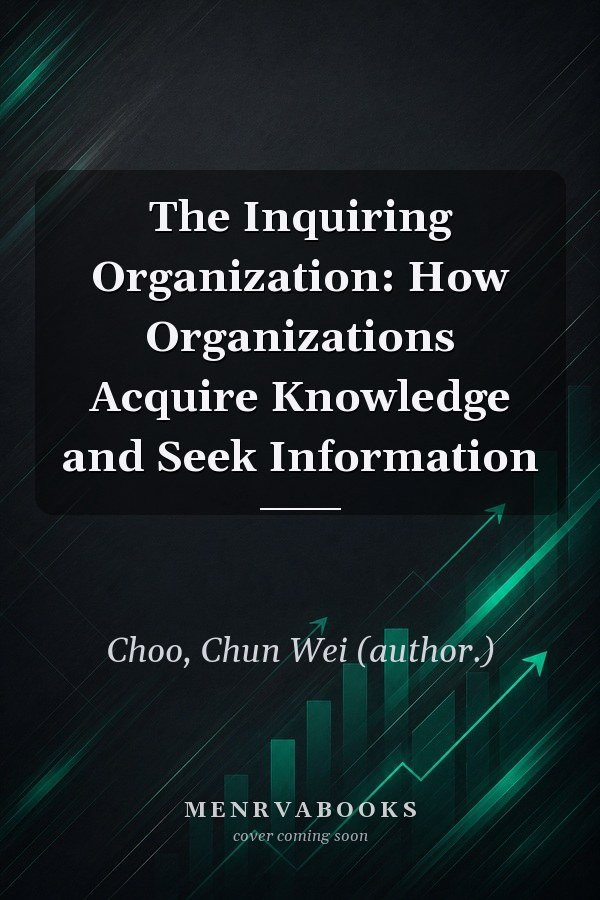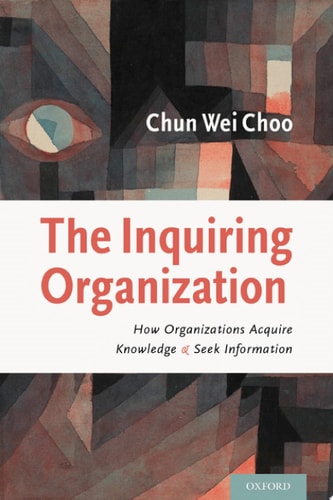
The Inquiring Organization: How Organizations Acquire Knowledge and Seek Information
0
0
As an Amazon Associate and affiliate partner, Menrva Books earns from qualifying purchases. Learn more
Author Description
Organizations behave as knowledge-seeking communities when their members share beliefs about cause-and-effect relationships, norms for evaluating information, and values that guide the translation of knowledge to practice. What are the practices, arrangements, and mechanisms that make up how an organization knows what it knows? What are the underlying values and norms that shape the character and orientation of these methods? What can we learn from failures and disasters in organizational learning -- and how do organizations become susceptible to common learning traps such as the self-fulfilling prophecy, groupthink, group polarization, learning myopia, and selective information processing?In The Inquiring Organization, Chun Wei Choo examines how an organization's knowledge-acquisition and information-seeking leads to the construction of beliefs and the formation of epistemic practices that can affect its capacity to learn and grow. The book explores the epistemology of organizational learning and information seeking; how organizations acquire and justify knowledge; and how information is sought and shaped to warrant as well as to question beliefs. It starts from the premise that organizations are truth-seeking -- they seek beliefs which are well supported by reasoning, evidence, and experience in order to act more effectively. It then makes the case for a normative view of organizational knowledge which identifies the epistemic norms that an organization needs to pursue in order to acquire valid knowledge and true belief. The book progressively develops a set of information and epistemic features that are used to describe an inquiring organization. An inquiring organization is one that is motivated to acquire knowledge, where this motivation for knowledge includes not only the pursuit of truth, but also understanding, creativity, and curiosity. It has developed norms and practices of information seeking and knowledge acquisition that are truth-conducive, granting i
Menrva's Summary
THE THESIS
How do organizations construct knowledge and navigate the epistemic processes required to transform information into effective action? Chun Wei Choo, a scholar in information management, utilizes a framework rooted in epistemology and organizational theory to investigate the mechanisms by which institutions acquire, justify, and utilize knowledge. He argues that organizations function as truth-seeking entities, yet they remain vulnerable to cognitive biases and systemic failures that impede their ability to learn and adapt.
THE SCOPE MAP
What You Will Find
- Analysis of organizational learning traps including groupthink, group polarization, and learning myopia.
- A normative framework for evaluating the epistemic quality of information-seeking practices.
- Examination of the relationship between organizational values, norms, and the translation of knowledge into practice.
- Theoretical exploration of how organizations justify beliefs through reasoning, evidence, and experience.
THE AUTHORITY PERSPECTIVE
Experts in the field of information science and management theory recognize this work as a rigorous exploration of the intersection between philosophy and organizational behavior. Readers frequently note the academic density of the prose, which serves as a foundational text for those studying the cognitive and structural dimensions of institutional learning.
Page Count:
248
Publication Date:
2015-12-18
Publisher:
Oxford University Press
ISBN-10:
0199782032
ISBN-13:
9780199782031
Business
Management
Epistemology
Information Science
Organizational Learning
Community Tags
Similar Books