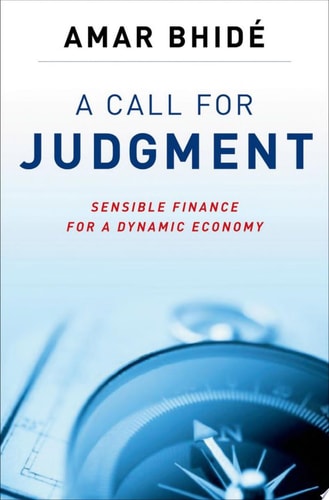
A Call for Judgment
0
0
As an Amazon Associate and affiliate partner, Menrva Books earns from qualifying purchases. Learn more
Author Description
Our Prosperity Requires The Enterprise Of Innumerable Individuals And Businesses Who Exercise Their Imagination And Judgment-and Bear Responsibility For Outcomes. And Widespread Enterprise Is Fostered Through Dialogue And Relationships, Not Merely Prices In Anonymous Markets. Yet Modern Finance Blatantly Neglects These Necessary Elements For Enterprise. In The Last Several Decades Finance Has Become Increasingly Centralized, Distanced, And Mechanistic. Instead Of Many Lending Officers Making Judgments About Borrowers They Know, Credit Decisions Are The Output Of The Models Of A Few Wall Street Wizards And Credit Agencies. This Robotic Centralized Finance Stifles The Dynamism Of The Real Economy And Leads To Recurring Collapses. A Call For Judgment Clearly Explains How Bad Theories And Mis-regulation Have Caused A Dangerous Divergence Between The Real Economy And Finance. In Simple Language Bhide Takes Apart The So-called Advances In Modern Finance, Showing How Backward-looking, Top-down Models Were Used To Mass-produce Toxic Products. Thanks To Excessively Tight Securities Laws And Loose Banking Laws, Anonymous Transactions Have Displaced Relationship-based Finance. And Bhide Offers, Tough Simple Rules For Restoring Relationships And Case-by-case Judgment: Limit Banks--and All Deposit Taking Institutions--to Basic Lending And Nothing Else. A Call For Judgment Is Both A Primer On The Role Of Finance In A Dynamic Modern Economy, And A Cautionary Tale About The Pitfalls Of Banks Functioning As Highly Centralized, Mechanistic Entities. It Is Essential Reading For Anyone Interested In Bringing The Economy Back To A Point At Which Decisions Can Be Made That Foster Organic Economic Growth Without The Potentially Disastrous Risks Currently Accepted By Modern Finance.
Menrva's Summary
THE THESIS
The central problem investigated is the dangerous divergence between the real economy and modern finance caused by the shift from relationship-based lending to centralized, mechanistic models. Amar V. Bhide, a professor at Tufts University and an expert in entrepreneurship and economic systems, utilizes historical analysis and institutional critique to argue that current financial regulations have stifled economic dynamism. He posits that the reliance on algorithmic credit decisions and anonymous market transactions has replaced the necessary human judgment required for sustainable growth. The book presents a framework for reform that prioritizes localized, relationship-based banking to mitigate systemic risk.
THE SCOPE MAP
What You Will Find
- Historical analysis of the evolution from relationship-based lending to centralized, model-driven finance.
- Critique of modern regulatory frameworks, specifically the impact of tight securities laws and loose banking laws.
- Case studies illustrating the failure of top-down, robotic financial models in predicting economic outcomes.
- Proposed policy reforms, including the restriction of deposit-taking institutions to basic lending activities.
THE AUTHORITY PERSPECTIVE
Experts and economists frequently cite this work as a critical examination of the structural flaws inherent in contemporary financial systems. Readers often note the accessibility of the prose, which translates complex economic theory into clear arguments for non-specialist audiences.
Page Count:
368
Publication Date:
2010-01-01
Publisher:
Oxford University Press
ISBN-10:
0199781443
ISBN-13:
9780199781447
Business
Economics
Banking
Finance
Public Policy
Community Tags
Similar Books