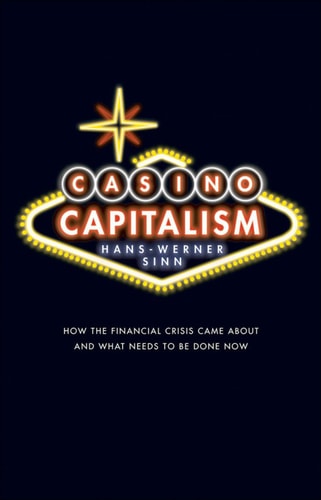
Casino Capitalism: How the Financial Crisis Came About and What Needs to be Done Now
0
0
As an Amazon Associate and affiliate partner, Menrva Books earns from qualifying purchases. Learn more
Author Description
In Casino Capitalism Hans-Werner Sinn examines the causes of the banking crisis, points out the flaws in the economic rescue packages, and presents a master plan for the reform of financial markets. Sinn argues that the crisis came about because limited liability induced both Wall Street and Main Street to gamble with real estate properties. He meticulously describes the process of lending to American homeowners and criticizes both the process of securitizing and selling mortgage claims to the world, as well as the poor job rating agencies did in providing transparency. He argues that the American Dream has ended because the world now realizes that this dream was built on loans that are never likely to be repaid. Sinn also asserts that the banking crisis has not yet been resolved, because the necessary write-offs of toxic assets have largely been swept under the carpet. Comparing actual worldwide write-offs with those estimated by the IMF estimates, he concludes that substantial parts, if not most, of the true losses have yet to be revealed and that the banking systems of many countries are on the brink of insolvency. In view of this, he directs sharp criticism at the various economic rescue packages, arguing that the plans assume that banks have a liquidity problem while, in fact, they suffer from a solvency crisis. Sinn points out that the conflict between the goals of rescuing banks in the short term and inducing more prudent behaviour in the long term requires the government to help the banks, but not their shareholders, by becoming a temporary co-owner. In addition, he calls for higher equity requirements, a worldwide return to more cautious accounting methods, a ban on extremely speculative short selling, and strict regulations on conduits, hedge funds and credit default swaps. This authoritative account provides an invaluable overview for academics, students, policymakers, politicians, and all those with an interest in the unprecedented 2008 banking crisis.
Menrva's Summary
THE THESIS
The core question investigated is how the structural flaws of the global financial system, specifically the incentives created by limited liability, precipitated the 2008 banking crisis and what regulatory reforms are required to prevent future systemic collapse. Hans-Werner Sinn, a prominent economist and former president of the Ifo Institute, utilizes his extensive background in macroeconomic theory and public policy to analyze the mechanics of the crisis. He argues that the crisis was fundamentally a solvency issue rather than a liquidity problem, and that government interventions failed to address the underlying toxic assets that continue to threaten global financial stability.
THE SCOPE MAP
What You Will Find
- Analysis of the securitization process and the role of mortgage-backed securities.
- Critique of credit rating agency performance and transparency failures.
- Comparative data between actual worldwide write-offs and IMF estimates.
- Proposed regulatory framework including higher equity requirements and restrictions on speculative instruments like credit default swaps.
Scope Limits
- The analysis is primarily focused on the 2008 financial crisis and does not cover subsequent economic developments post-2010.
- The text does not provide a comprehensive history of banking, focusing instead on the specific mechanisms of the subprime mortgage collapse.
THE AUTHORITY PERSPECTIVE
Experts and academics recognize this work as a rigorous, technically dense critique of the regulatory failures that defined the 2008 crisis. Readers frequently note that the author's arguments regarding solvency versus liquidity remain a central point of debate in contemporary financial policy discussions.
Page Count:
374
Publication Date:
2010-01-01
Publisher:
OUP Oxford
ISBN-10:
0191625078
ISBN-13:
9780191625077
Economics
Business
Banking
Finance
Public Policy
Community Tags
Other Editions(2)

Similar Books








Reader Comments
Share Your Thoughts
No comments yet. Be the first to share your thoughts!