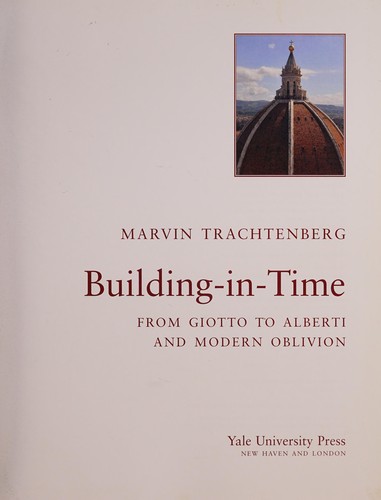
Building-in-Time from Giotto to Alberti and Modern Oblivion
0
0
As an Amazon Associate and affiliate partner, Menrva Books earns from qualifying purchases. Learn more
Author Description
In the pre-modern age in Europe, the architect built not merely with imagination, bricks and mortar, but with time, using vast quantities of duration as the means to erect monumental buildings that otherwise would have been impossible to achieve. Virtually all the great cathedrals of France and the rest of Europe were built by this deliberate practice, here given the name "Building-in-Time". It places an entirely new light on the major works of pre-modern Italy, from the Pisa cathedral group to the cathedrals of Milan, Venice and Siena, and from the monuments of fourteenth-century Florence to the new St Peter's. Even as this temporal regime was flourishing, the fifteenth-century Italian architect Leon Battista Alberti proposed a new one for architecture, in which time would ideally be excluded from the making of architecture ("Building-outside-Time"). Planning and building, which had always formed one fluid, imbricated process, were to be sharply divided, and the change that always came with time was to be excluded from architectural making.
Menrva's Summary
THE THESIS
of this book is that pre-modern European architecture was constructed not only with physical materials but also with vast quantities of time, a practice termed 'Building-in-Time'.** This temporal regime enabled the erection of monumental structures like cathedrals, which would otherwise have been impossible. The book examines how this practice shaped major works from Italy, including the Pisa cathedral group, cathedrals of Milan, Venice, and Siena, and monuments of 14th-century Florence, as well as the new St. Peter's Basilica. It also contrasts this with Leon Battista Alberti's 15th-century proposal for 'Building-outside-Time', which sought to exclude duration from the architectural process by sharply dividing planning and building.
THE SCOPE MAP
- The concept of 'Building-in-Time' as a method for constructing monumental architecture using duration.
- Analysis of major pre-modern Italian architectural works, including cathedrals and basilicas.
- The influence of architects like Giotto and Leon Battista Alberti on architectural practices.
- The shift from 'Building-in-Time' to 'Building-outside-Time' in the Renaissance.
- The deliberate practice of incorporating vast quantities of time into the building process.
- The separation of planning and building as proposed by Alberti.
- The exclusion of change and time from architectural making.
THE AUTHORITY PERSPECTIVE
The book is recognized for its novel conceptualization of architectural history, introducing the term 'Building-in-Time' to describe a fundamental aspect of pre-modern construction. Scholars have noted its detailed examination of Italian architectural achievements and the significant shift proposed by Alberti. The work is considered a valuable contribution to the understanding of architectural theory and practice across different historical periods. It offers a new lens through which to view the creation of enduring structures.
Page Count:
490
Publication Date:
2010-01-01
ISBN-10:
0300165927
ISBN-13:
9780300165920
Philosophy
History
Non-Fiction
Architecture
Art History
Community Tags
Similar Books














