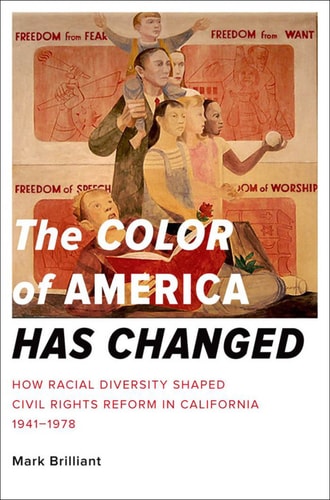
The Color of America Has Changed: How Racial Diversity Shaped Civil Rights Reform in California, 1941-1978
0
0
As an Amazon Associate and affiliate partner, Menrva Books earns from qualifying purchases. Learn more
Author Description
From the moment that the attack on the "problem of the color line," as W.E.B. DuBois famously characterized the problem of the twentieth century, began to gather momentum nationally during World War II, California demonstrated that the problem was one of color lines. In The Color of America Has Changed, Mark Brilliant examines California's history to illustrate how the civil rights era was a truly nationwide and multiracial phenomenon-one that was shaped and complicated by the presence of not only blacks and whites, but also Mexican Americans, Japanese Americans, and Chinese Americans, among others. Focusing on a wide range of legal and legislative initiatives pursued by a diverse group of reformers, Brilliant analyzes the cases that dismantled the state's multiracial system of legalized segregation in the 1940s and subsequent battles over fair employment practices, old-age pensions for long-term resident non-citizens, fair housing, agricultural labor, school desegregation, and bilingual education. He concludes with the conundrum created by the multiracial affirmative action program at issue in the United States Supreme Court's 1978 Regents of the University of California v. Bakke decision. The Golden State's status as a civil rights vanguard for the nation owes in part to the numerous civil rights precedents set there and to the disparate challenges of civil rights reform in multiracial places. While civil rights historians have long set their sights on the South and recently have turned their attention to the North, advancing a "long civil rights movement" interpretation, Mark Brilliant calls for a new understanding of civil rights history that more fully reflects the racial diversity of America.
Menrva's Summary
THE THESIS
How did the unique multiracial landscape of California redefine the trajectory of the American civil rights movement between 1941 and 1978? Mark Brilliant, a historian specializing in twentieth-century American social and political history, utilizes extensive archival research and legal analysis to challenge the traditional binary focus on Black-White relations. He argues that California’s diverse demographic composition necessitated a more complex, multifaceted approach to civil rights reform that transcended the regional limitations of the American South and North.
THE SCOPE MAP
What You Will Find
- Analysis of legal and legislative initiatives regarding fair employment, housing, and school desegregation.
- Examination of the specific civil rights challenges faced by Mexican Americans, Japanese Americans, and Chinese Americans.
- Case studies of landmark litigation, including the 1978 Regents of the University of California v. Bakke decision.
- A historical framework that shifts the focus from a singular color line to a multiracial system of legalized segregation.
THE AUTHORITY PERSPECTIVE
Scholars and historians identify this work as a significant contribution to the 'long civil rights movement' historiography by expanding the geographic and racial scope of the field. Readers frequently note the academic density of the prose and the author's meticulous attention to the nuances of California's legislative history.
Page Count:
379
Publication Date:
2010-01-01
Publisher:
Oxford University Press
ISBN-10:
0199798818
ISBN-13:
9780199798810
History
Ethnic Studies
United States
Race Relations
California history
Sociology
American History
Civil Rights
Community Tags
Similar Books














