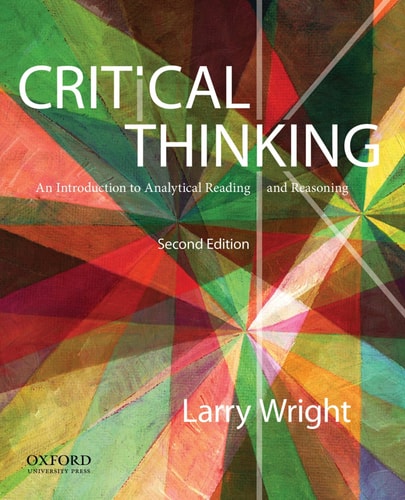
Critical Thinking: An Introduction to Analytical Reading and Reasoning
0
0
As an Amazon Associate and affiliate partner, Menrva Books earns from qualifying purchases. Learn more
Author Description
Critical Thinking: An Introduction to Analytical Reading and Reasoning, Second Edition, provides a nontechnical vocabulary and analytic apparatus that guide students in identifying and articulating the central patterns found in reasoning and in expository writing more generally. Understanding these patterns of reasoning helps students to better analyze, evaluate, and construct arguments and to more easily comprehend the full range of everyday arguments found in ordinary journalism.Critical Thinking, Second Edition, distinguishes itself from other texts in the field by emphasizing analytical reading as an essential skill. It also provides detailed coverage of argument analysis, diagnostic arguments, diagnostic patterns, and fallacies.Opening with two chapters on analytical reading that help students recognize what makes reasoning explicitly different from other expository activities, the text then presents an interrogative model of argument to guide them in the analysis and evaluation of reasoning. This model allows a detailed articulation of "inference to the best explanation" and gives students a view of the pervasiveness of this form of reasoning. The author demonstrates how many common argument types--from correlations to sampling--can be analyzed using this articulated form. He then extends the model to deal with several predictive and normative arguments and to display the value of the fallacy vocabulary.Ideal for introductory courses in critical thinking, critical reasoning, informal logic, and inductive reasoning, Critical Thinking, Second Edition, features hundreds of exercises throughout and includes worked-out solutions and additional exercises (without solutions) at the end of each chapter. An Instructor's Manual--offering solutions to the text's unanswered exercises and featuring other pedagogical aids--is available on the book's Companion Website at www.oup.com/us/wright.
Menrva's Summary
THE THESIS
This text investigates the fundamental question of how students can effectively identify, analyze, and construct logical arguments within everyday expository writing. Larry Wright, an experienced educator in the field of informal logic, provides a nontechnical framework designed to demystify the structure of reasoning. By focusing on analytical reading as a primary skill, the author equips readers with a diagnostic apparatus to evaluate arguments found in journalism and general discourse. The book utilizes an interrogative model to help students articulate complex patterns of inference and explanation.
THE SCOPE MAP
What You Will Find
- An analytical reading framework for distinguishing reasoning from other forms of expository writing
- An interrogative model for evaluating inference to the best explanation
- Detailed coverage of diagnostic patterns, argument types, and common logical fallacies
- Hundreds of practical exercises with worked-out solutions to reinforce conceptual understanding
THE AUTHORITY PERSPECTIVE
Instructors and students frequently highlight this text as a foundational resource for introductory courses in informal logic and critical reasoning. The prose is noted for its accessibility, providing a clear and structured approach to complex analytical tasks.
Page Count:
416
Publication Date:
2012-10-29
Publisher:
Oxford University Press
ISBN-10:
019979622X
ISBN-13:
9780199796229
Philosophy
Education
Critical thinking
Reference
Logic
Community Tags
Other Editions(3)
Similar Books
Reader Comments
Share Your Thoughts
No comments yet. Be the first to share your thoughts!