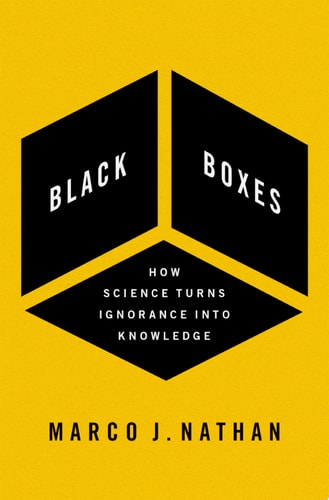
Black Boxes: How Science Turns Ignorance Into Knowledge
0
0
As an Amazon Associate and affiliate partner, Menrva Books earns from qualifying purchases. Learn more
Author Description
Textbooks and other popular venues commonly present science as a progressive "brick-by-brick" accumulation of knowledge and facts. Despite its hallowed history and familiar ring, this depiction is nowadays rejected by most specialists. There currently are two competing models of the scientific enterprise: reductionism and antireductionism. Neither provides an accurate depiction of the productive interaction between knowledge and ignorance, supplanting the old metaphor of the "wall" of knowledge. This book explores an original conception of the nature and advancement of science. Marco J. Nathan's proposed shift brings attention to a prominent, albeit often neglected, construct--the black box--which underlies a well-oiled technique for incorporating a productive role of ignorance and failure into the acquisition of empirical knowledge. The black box is a metaphorical term used by scientists for the isolation of a complex phenomenon that they have deliberately set aside or may not yet fully understand. What is a black box? How does it work? How do we construct one? How do we determine what to include and what to leave out? What role do boxes play in contemporary scientific practice? Nathan's monograph develops an overarching framework for thinking about black boxes and discusses prominent historical cases that used it, including Darwin's view of inheritance in his theory of evolution and the "stimulus-response model" in psychology, among others. By detailing some fascinating episodes in the history of biology, psychology, and economics, Nathan revisits foundational questions about causation, explanation, emergence, and progress, showing how the insights of both reductionism and antireductionism can be reconciled into a fresh and exciting approach to science.
Menrva's Summary
THE THESIS
How does the scientific enterprise effectively integrate ignorance and failure into the systematic acquisition of empirical knowledge? Marco J. Nathan, a scholar in the philosophy of science, challenges the traditional "brick-by-brick" model of scientific progress. He proposes a new framework centered on the concept of the "black box," arguing that scientists intentionally isolate complex, poorly understood phenomena to facilitate productive research and reconcile the competing paradigms of reductionism and antireductionism.
THE SCOPE MAP
What You Will Find
- A conceptual framework defining the construction and utility of black boxes in scientific practice.
- Historical case studies from biology, psychology, and economics.
- Analysis of Darwinian inheritance models and stimulus-response psychological theories.
- Philosophical examination of causation, emergence, and scientific explanation.
Scope Limits
- The text does not provide a comprehensive history of all scientific disciplines.
- It focuses primarily on the philosophical mechanics of knowledge acquisition rather than technical laboratory protocols.
THE AUTHORITY PERSPECTIVE
Experts recognize this work as a significant contribution to the philosophy of science, particularly for its attempt to bridge the gap between reductionist and antireductionist schools of thought. Readers frequently note the academic density of the prose, which is best suited for those with a background in epistemology or the history of scientific methodology.
Page Count:
308
Publication Date:
2021-01-01
Publisher:
Oxford University Press
ISBN-10:
0190095504
ISBN-13:
9780190095505
Philosophy
Science
Philosophy of
Science History
Methodology
Epistemology
Community Tags
Similar Books