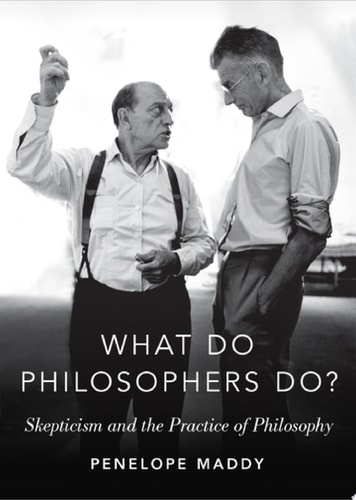
What Do Philosophers Do?: Skepticism and the Practice of Philosophy
0
0
As an Amazon Associate and affiliate partner, Menrva Books earns from qualifying purchases. Learn more
Author Description
How do you know the world around you isn't just an elaborate dream, or the creation of an evil neuroscientist? If all you have to go on are various lights, sounds, smells, tastes and tickles, how can you know what the world is really like, or even whether there is a world beyond your own mind? Questions like these -- familiar from science fiction and dorm room debates -- lie at the core of venerable philosophical arguments for radical skepticism: the stark contention that we in fact know nothing at all about the world, that we have no more reason to believe any claim -- that there are trees, that we have hands -- than we have to disbelieve it. Like non-philosophers in their sober moments, philosophers, too, find this skeptical conclusion preposterous, but they're faced with those famous arguments: the Dream Argument, the Argument from Illusion, the Infinite Regress of Justification, the more recent Closure Argument. If these can't be met, they raise a serious challenge not just to philosophers, but to anyone responsible enough to expect her beliefs to square with her evidence. What Do Philosophers Do? takes up the skeptical arguments from this everyday point of view, and ultimately concludes that they don't undermine our ordinary beliefs or our ordinary ways of finding out about the world. In the process, Maddy examines and evaluates a range of philosophical methods -- common sense, scientific naturalism, ordinary language, conceptual analysis, therapeutic approaches -- as employed by such philosophers as Thomas Reid, G. E. Moore, Ludwig Wittgenstein, and J. L. Austin. The result is a revealing portrait of what philosophers do, and perhaps a quiet suggestion for what they should do, for what they do best.
Menrva's Summary
THE THESIS
This book investigates the validity of radical skepticism and evaluates the efficacy of various philosophical methods in addressing the challenge of whether we can truly know the external world. Penelope Maddy, a distinguished philosopher of science and mathematics, utilizes her expertise to bridge the gap between abstract skeptical arguments and everyday common sense. She examines the logical structure of classic skeptical challenges, such as the Dream Argument and the Closure Argument, to determine if they successfully undermine our ordinary beliefs about reality. Through this analysis, she provides a critical assessment of how different philosophical schools approach the problem of knowledge.
THE SCOPE MAP
What You Will Find
- Analysis of classic skeptical arguments including the Dream Argument, the Argument from Illusion, and the Infinite Regress of Justification.
- Comparative evaluation of philosophical methodologies such as scientific naturalism, ordinary language philosophy, and conceptual analysis.
- Historical perspectives on the works of Thomas Reid, G. E. Moore, Ludwig Wittgenstein, and J. L. Austin.
Scope Limits
- The text does not provide a comprehensive history of all Western philosophy.
- It does not attempt to resolve every metaphysical question, focusing primarily on the epistemological challenge of skepticism.
THE AUTHORITY PERSPECTIVE
Experts and academics recognize this work as a clear, accessible entry point into the meta-philosophical debate regarding the purpose and utility of philosophical inquiry. Readers frequently note that Maddy’s prose remains grounded and precise, making complex epistemological problems approachable for those outside of specialized academic circles.
Page Count:
260
Publication Date:
2016-01-01
Publisher:
Oxford University Press
ISBN-10:
019061871X
ISBN-13:
9780190618711
Philosophy
Methodology
Skepticism
Epistemology
Academic
Metaphilosophy
Community Tags
Similar Books